
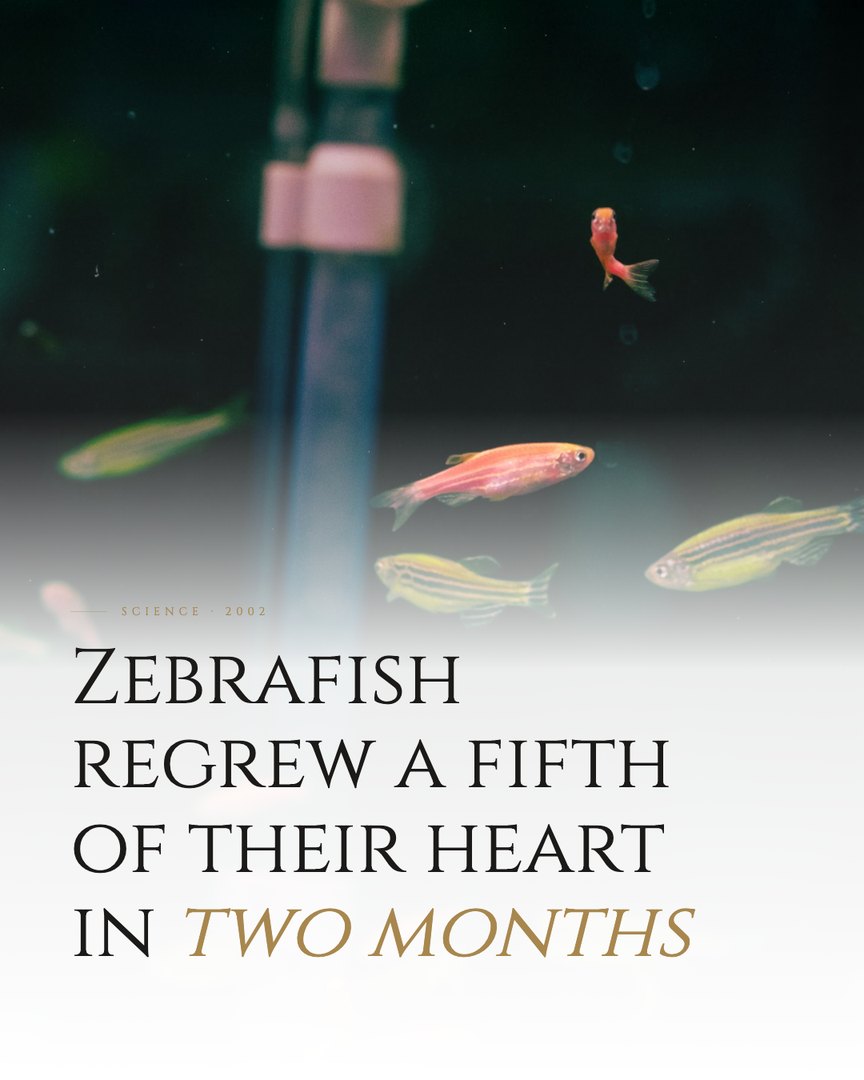
Researchers at Harvard Medical School cut away about 20 percent of an adult zebrafish's ventricle, the heart's main pumping chamber, to see whether the fish, unlike mammals, could rebuild what was lost.
Within two months, the removed section had fully regenerated, with new heart muscle cells dividing at the wound's edge to rebuild the missing tissue rather than sealing it over with scar. A mutant zebrafish strain with a cell-division defect failed to regenerate and formed a scar instead, confirming active cell division drove the recovery.
The result established zebrafish as a working model for studying how a vertebrate heart can regrow muscle instead of scarring, a capacity adult mammals largely lack. It did not answer why mammalian hearts default to scarring instead, a question that later work in the same field, including the Cold War-era carbon dating of human heart cells, continued to chase from a different angle.
Read the original study
Poss, Wilson and Keating, Science, 2002 · doi.org/10.1126/science.1077857
Cut a fifth away, grow it back whole.
Source
- Poss, K. D., Wilson, L. G., & Keating, M. T. (2002). Heart regeneration in zebrafish. Science, 298(5601), 2188–90. https://doi.org/10.1126/science.1077857