
Researchers at Newcastle University timed how quickly people moved wet objects of different sizes using wrinkled fingers compared with unwrinkled ones, to test whether the wrinkling pattern did anything useful.
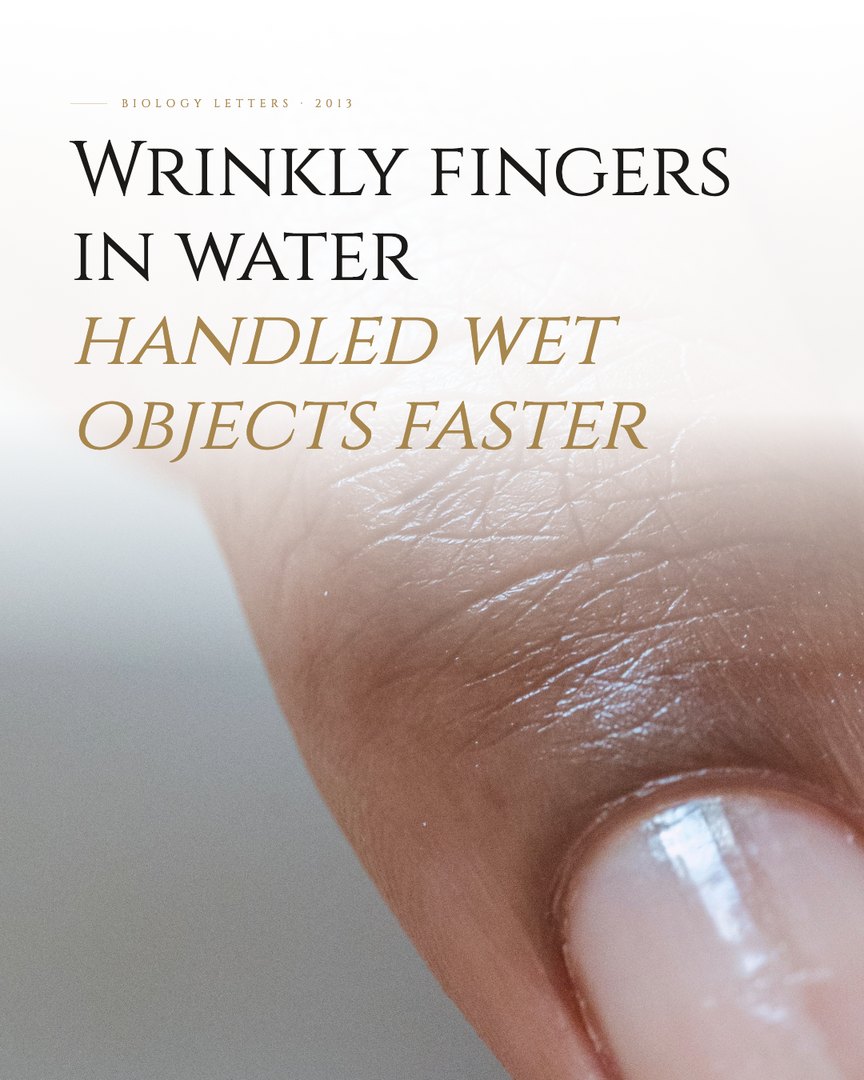
Participants with water-wrinkled fingertips handled submerged marbles and other wet objects faster than they did with unwrinkled fingers, moving them between containers more quickly. On dry objects handled in air, wrinkled and unwrinkled fingers performed about the same, showing the advantage only appeared when the objects were wet.
The pattern of wrinkles resembles drainage channels, similar to rain treads on a tire, which may let water escape from between the finger and a wet surface and increase contact and grip. The finding reframed a reaction long treated as incidental as a plausible adaptation, though a 2014 replication found no advantage and a 2021 study found one, so the question remains open.
Read the original study
Kareklas et al., Biology Letters, 2013 · doi.org/10.1098/rsbl.2012.0999
Wrinkled skin may be a grip tool after all.
Source
- Kareklas, K., Nettle, D., & Smulders, T. V. (2013). Water-induced finger wrinkles improve handling of wet objects. Biology Letters, 9(2), 20120999. https://doi.org/10.1098/rsbl.2012.0999