
The condition came from the immune system attacking pigment-producing cells, and most treatment options only slowed its spread. Researchers tested a topical cream called ruxolitinib, already used for certain blood and skin disorders, to see whether it could do more.
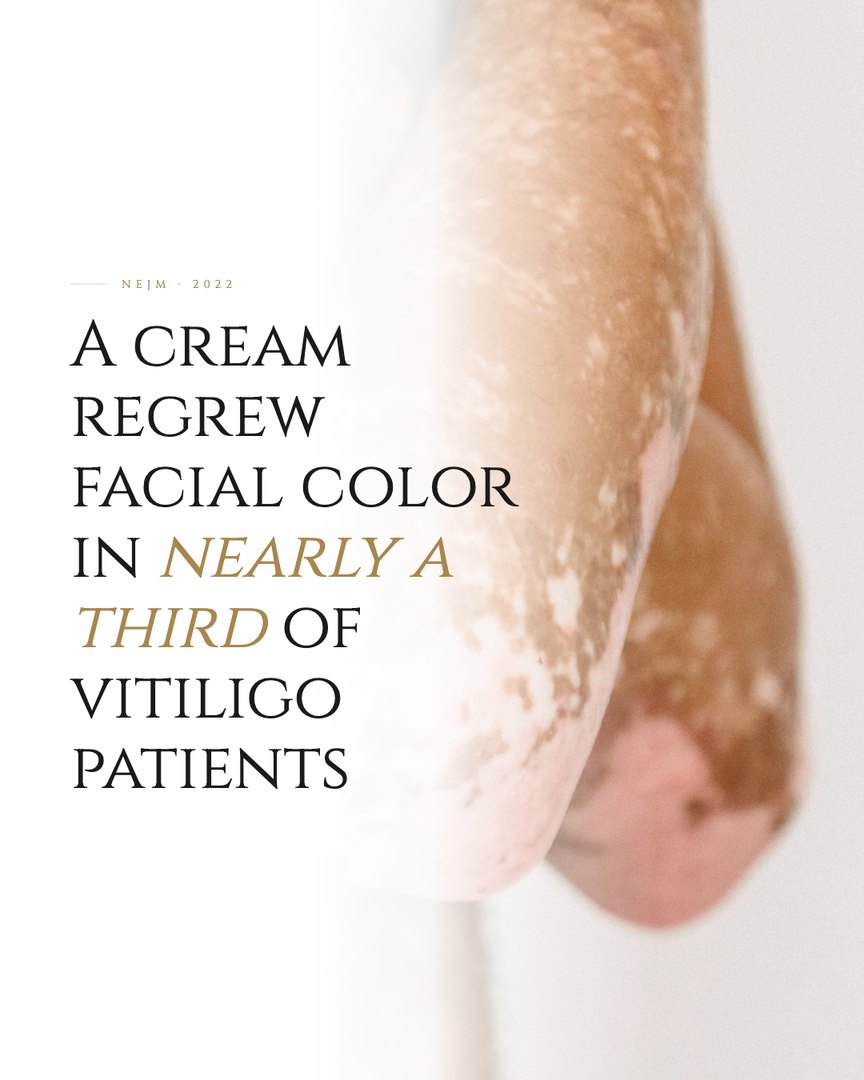
Researchers led by David Rosmarin ran two international trials, called TRuE-V1 and TRuE-V2, applying ruxolitinib cream twice daily to patches on the face and body. After 24 weeks, close to three in ten patients regained at least 75 percent of facial pigment, compared with roughly one in ten on a plain vehicle cream.
Repigmentation kept improving the longer patients used the cream, reaching roughly half of treated patients by one year in follow-up analysis. The cream became the first FDA-approved topical treatment specifically for vitiligo repigmentation. Results were slower and smaller on the body than the face, and color did not return for every patient who used it.
Read the original study
Color came back, slowly but measurably.
Source
- Rosmarin, D., Passeron, T., Pandya, A. G., Grimes, P., Harris, J. E., Desai, S. R., Lebwohl, M., Ruer-Mulard, M., Seneschal, J., Wolkerstorfer, A., Kornacki, D., Sun, K., Butler, K., Ezzedine, K., & TRuE-V Study Group (2022). Two Phase 3, Randomized, Controlled Trials of Ruxolitinib Cream for Vitiligo. New England Journal of Medicine, 387(16), 1445–1455. https://doi.org/10.1056/NEJMoa2118828