
Researchers at the University of Sydney analyzed wrist accelerometer data from people who reported no leisure-time exercise at all, to see whether those brief, incidental bursts of vigorous movement embedded in ordinary daily life showed up in their long-term health outcomes.
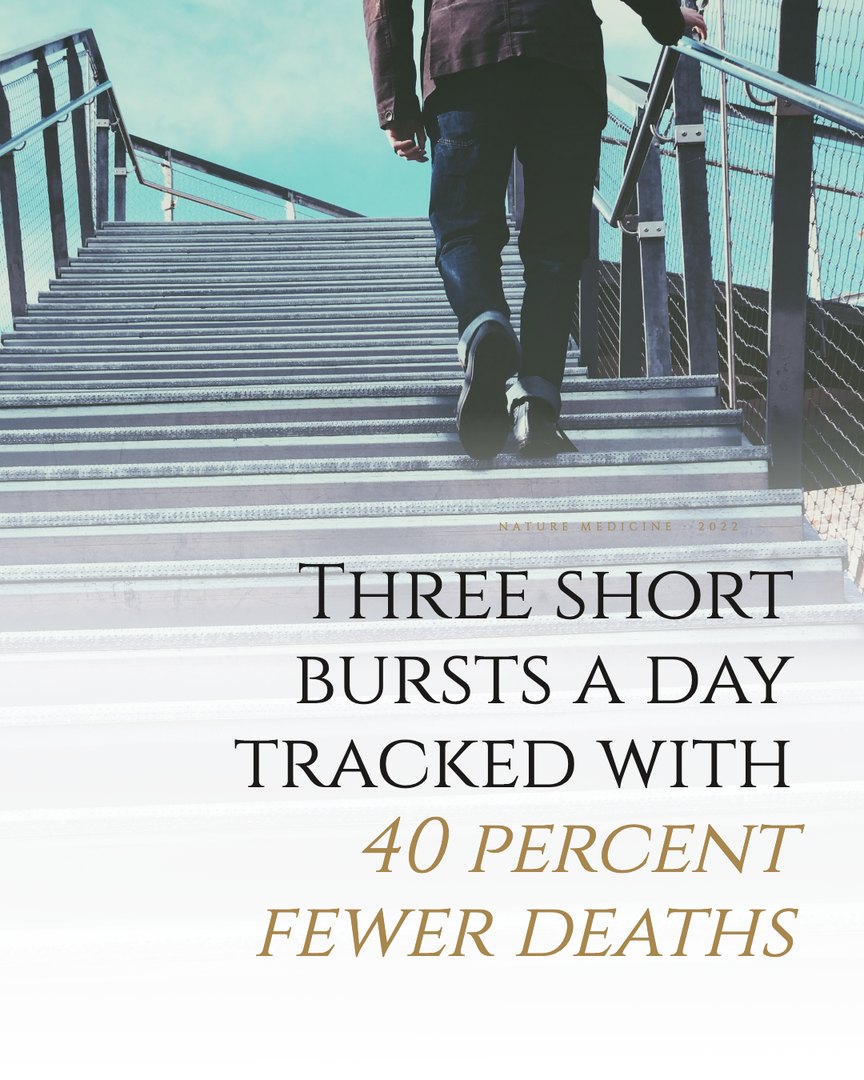
Among 25,241 non-exercisers in the UK Biobank followed for almost seven years, those who logged a median of about three short vigorous bursts a day, each lasting roughly one to two minutes, had close to 38 to 40 percent lower all-cause and cancer mortality and nearly 49 percent lower cardiovascular mortality than those with no such bursts at all.
The researchers coined the term VILPA, vigorous intermittent lifestyle physical activity, to describe these unplanned bursts woven into errands and chores rather than scheduled workouts. Because the activity was measured by wearable devices rather than assigned by the researchers, the study shows a strong association in people who already move this way, not direct proof that deliberately adding such bursts would produce the same benefit for everyone.
Read the original study
Stamatakis et al., Nature Medicine, 2022 · doi.org/10.1038/s41591-022-02100-x
A few minutes of hustle, hidden in plain sight.
Source
- Stamatakis, E., Ahmadi, M. N., Gill, J. M. R., Thøgersen-Ntoumani, C., Gibala, M. J., Doherty, A., & Hamer, M. (2022). Association of wearable device-measured vigorous intermittent lifestyle physical activity with mortality. Nature Medicine, 28(12), 2521–2529. https://doi.org/10.1038/s41591-022-02100-x