
Researchers at the National Institutes of Health admitted 20 adults to a metabolic ward for four weeks, feeding them an ultra-processed diet for two weeks and an unprocessed diet for two weeks, with both diets matched for calories, sugar, fat, fiber, and sodium.
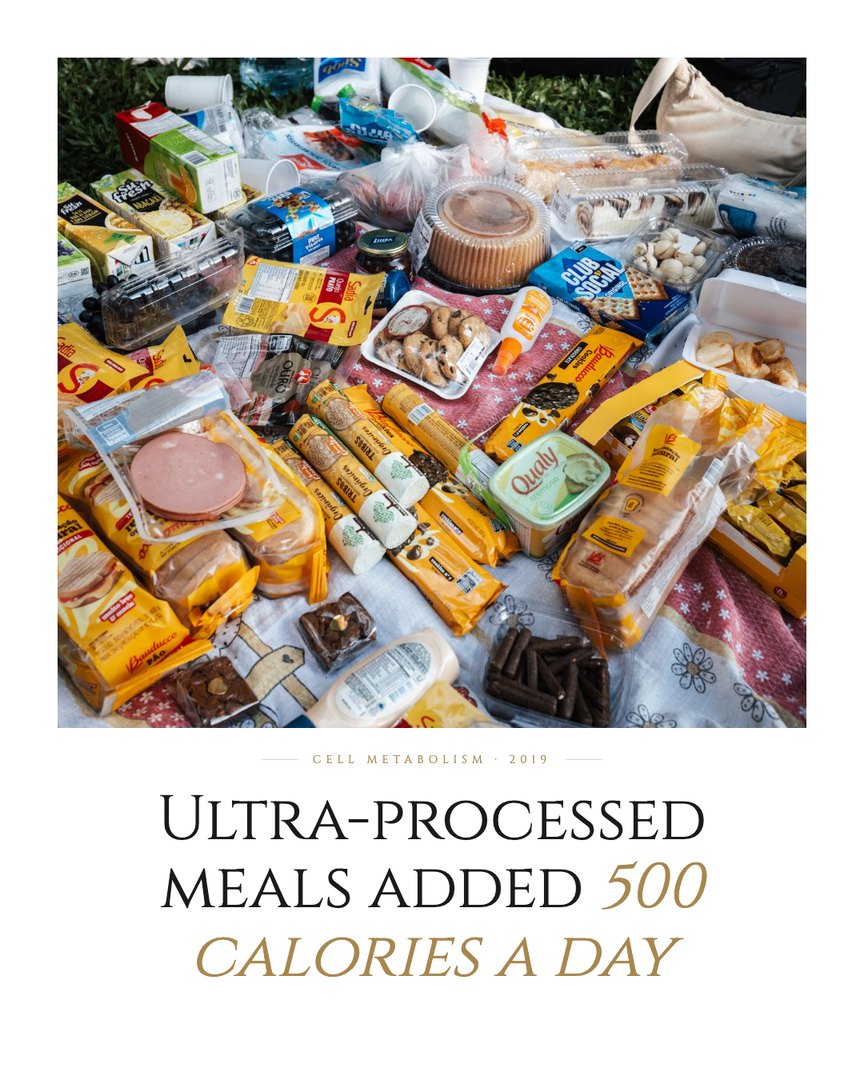
Participants could eat as much as they wanted from each diet, and on the ultra-processed diet they ate about 500 more calories per day than on the unprocessed diet, without reporting feeling any more or less full. Over two weeks, people gained about 0.9 kilograms on the ultra-processed diet and lost a similar amount on the unprocessed one.
Both diets were designed by nutritionists to be equally matched on paper, nutrient for nutrient, which makes the 500-calorie gap harder to explain by nutrition content alone and points instead to something about the processing itself, possibly eating speed, texture, or how satisfying the food felt bite for bite. The study was small and lasted only two weeks per diet, but its controlled, inpatient design pointed squarely at processing itself.
Read the original study
Hall et al., Cell Metabolism, 2019 · doi.org/10.1016/j.cmet.2019.05.008
Same nutrients, 500 extra calories anyway.
Source
- Hall, K. D., Ayuketah, A., Brychta, R., Cai, H., Cassimatis, T., Chen, K. Y., Chung, S. T., Costa, E., Courville, A., Darcey, V., Fletcher, L. A., Forde, C. G., Gharib, A. M., Guo, J., Howard, R., Joseph, P. V., McGehee, S., Ouwerkerk, R., Raisinger, K., . . . Zhou, M. (2019). Ultra-Processed Diets Cause Excess Calorie Intake and Weight Gain: An Inpatient Randomized Controlled Trial of Ad Libitum Food Intake. Cell Metabolism, 30(1), 67–77.e3. https://doi.org/10.1016/j.cmet.2019.05.008