
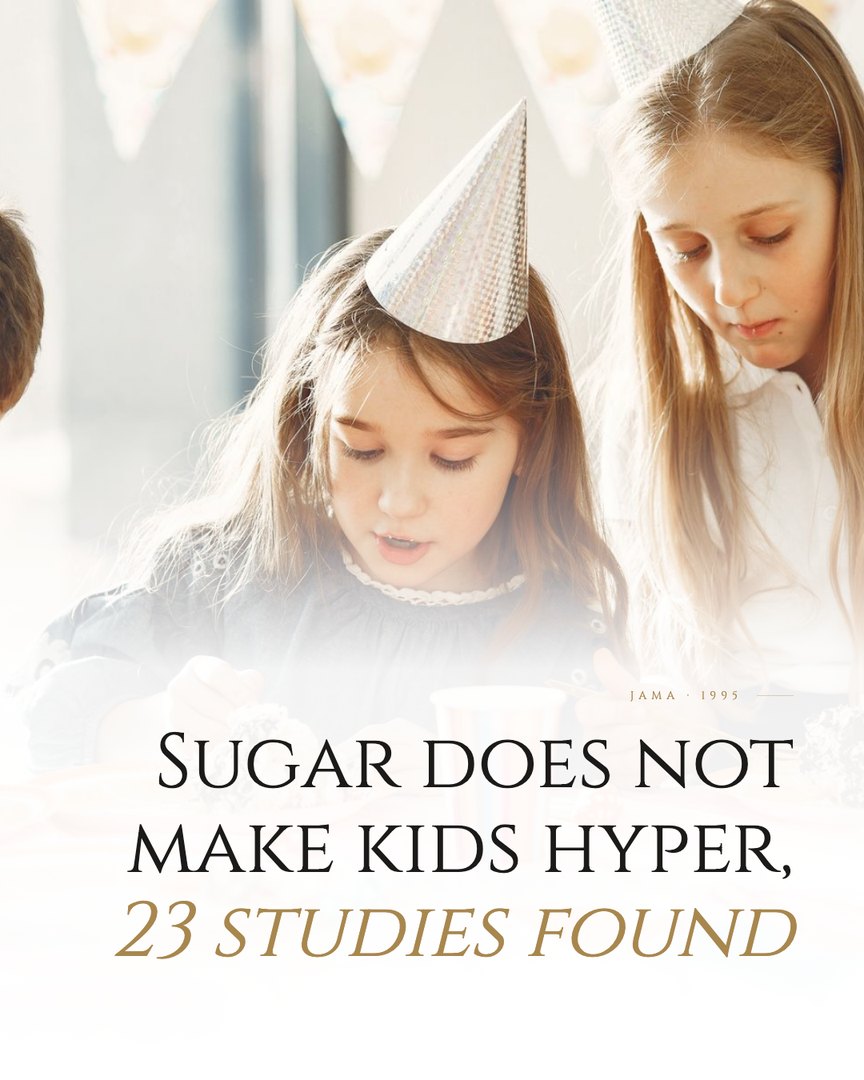
Researchers at Vanderbilt University pooled every controlled study they could find testing sugar against children's behavior and thinking. The 23 double-blind trials included kids with ADHD, kids their parents called sugar-sensitive, and ordinary children with no behavior concerns.
Across sucrose, fructose, and glucose, at a range of doses, the pooled data showed no consistent effect of sugar on behavior or cognitive performance, including among children whose parents were convinced sugar set them off. The authors noted that a small effect in some children could not be ruled out.
The authors suggested that parents' belief in a sugar effect may come from expectation rather than observation, since sugary treats are often eaten at birthday parties and holidays already full of excitement. The finding has been revisited periodically since 1995 and has largely held, though the belief itself remains common among parents and some caregivers decades later.
Read the original study
Wolraich, Wilson and White, JAMA, 1995 · doi.org/10.1001/jama.1995.03530200053037
The myth outlasted the data.
Source
- Wolraich, M. L. (1995). The Effect of Sugar on Behavior or Cognition in Children. JAMA, 274(20), 1617. https://doi.org/10.1001/jama.1995.03530200053037