
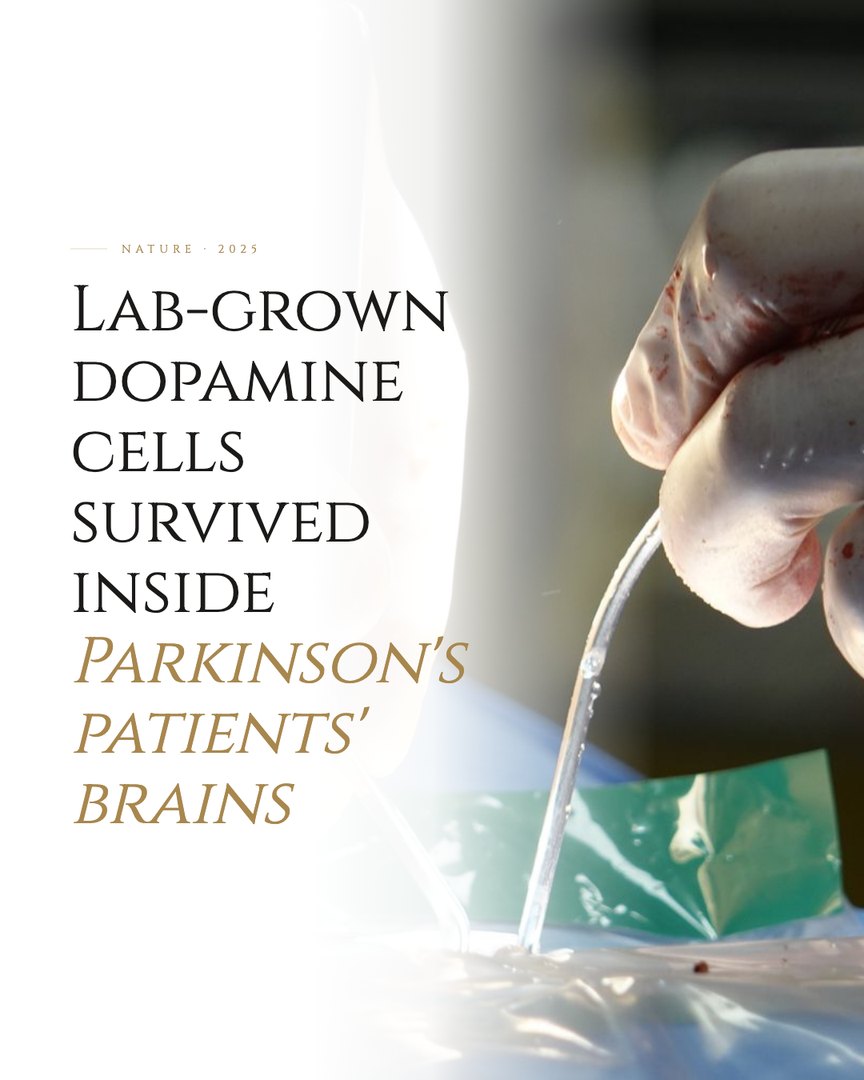
In the 1980s and 1990s, surgeons tried transplanting dopamine cells from aborted fetal tissue, with inconsistent results and little ability to control cell quality or dose. Researchers led by Viviane Tabar grew a standardized batch of dopamine neuron precursors from human embryonic stem cells instead.
Twelve patients with Parkinson's had the lab-grown cells, called bemdaneprocel, surgically grafted into both sides of the putamen. Brain imaging eighteen months later showed the transplanted cells had survived and were making dopamine, and the higher-dose group improved by an average of 23 points on the standard motor score measured off medication.
No patient developed the uncontrolled involuntary movements that undermined some earlier fetal-tissue transplants, an early safety signal in a trial of only twelve people. Because the cells come from a stem cell line rather than donated tissue, the supply can in principle be standardized and scaled, and a larger controlled trial is the next test of whether the motor gains hold up against a placebo surgery.
Read the original study
Tabar et al., Nature, 2025 · doi.org/10.1038/s41586-025-08845-y
New dopamine cells took root and worked.
Source
- Tabar, V., Sarva, H., Lozano, A. M., Fasano, A., Kalia, S. K., Yu, K. K. H., Brennan, C., Ma, Y., Peng, S., Eidelberg, D., Tomishima, M., Irion, S., Stemple, W., Abid, N., Lampron, A., Studer, L., & Henchcliffe, C. (2025). Phase I trial of hES cell-derived dopaminergic neurons for Parkinson's disease. Nature, 641(8064), 978–983. https://doi.org/10.1038/s41586-025-08845-y