
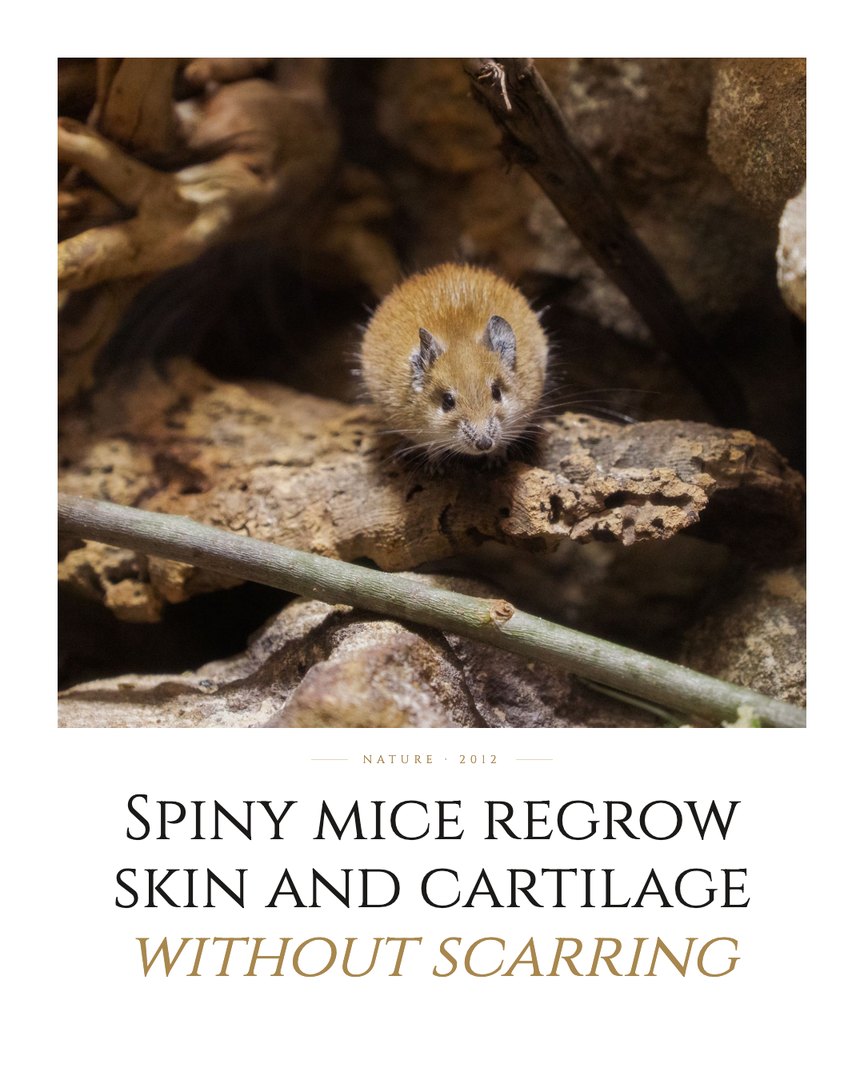
Researchers at the University of Florida studying African spiny mice in Kenya noticed the animals' skin tore away easily when grabbed, letting them slip a predator's grip, and wanted to see what happened to the wound afterward.
The skin wounds contracted quickly and grew back hair follicles with little scarring, and when the researchers punched a hole clean through the animals' ears, the hole closed with regrown skin, glands and cartilage, a tissue that normal lab mice cannot regenerate at all in that location.
The discovery meant a true mammal, not an amphibian or a fish, could regenerate complex tissue with minimal scarring, overturning an assumption that mammals had lost that capacity somewhere in their evolutionary past. The spiny mouse has since become a model species for finding the genetic switches behind scar-free healing, with the goal of understanding why most mammals, including humans, cannot do the same.
Read the original study
A mammal that heals like a lizard.
Source
- Seifert, A. W., Kiama, S. G., Seifert, M. G., Goheen, J. R., Palmer, T. M., & Maden, M. (2012). Skin shedding and tissue regeneration in African spiny mice (Acomys). Nature, 489(7417), 561–5. https://doi.org/10.1038/nature11499