
Researchers working with the China Kadoorie Biobank followed 487,375 adults for an average of about seven years, tracking how often they ate spicy food and comparing that against who died and from what cause.
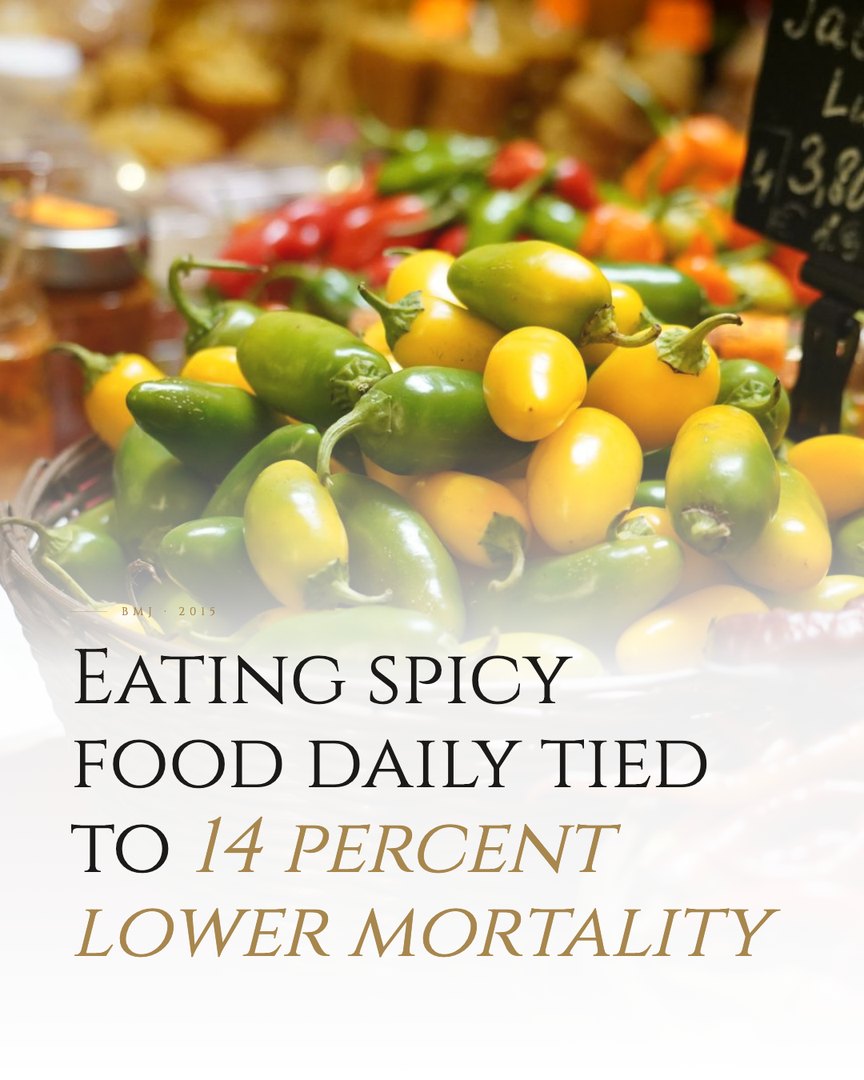
People who ate spicy food almost every day had about a 14 percent lower risk of dying during the study than people who ate it less than once a week, after adjusting for age, income, smoking, and other health factors. The association held for deaths from cancer, heart disease, and respiratory illness alike.
This is an observational study, so it cannot prove that chili itself extends life, since people who eat more spicy food also tend to differ from those who do not in diet, lifestyle, and other habits researchers could not fully account for. Capsaicin, the compound that makes chili peppers hot, has measurable effects on metabolism and inflammation in laboratory studies, which gives the correlation a plausible biological story.
Read the original study
A little heat, a little less mortality.
Source
- Lv, J., Qi, L., Yu, C., Yang, L., Guo, Y., Chen, Y., Bian, Z., Sun, D., Du, J., Ge, P., Tang, Z., Hou, W., Li, Y., Chen, J., Chen, Z., Li, L., & China Kadoorie Biobank Collaborative Group (2015). Consumption of spicy foods and total and cause specific mortality: population based cohort study. BMJ, 351, h3942. https://doi.org/10.1136/bmj.h3942