
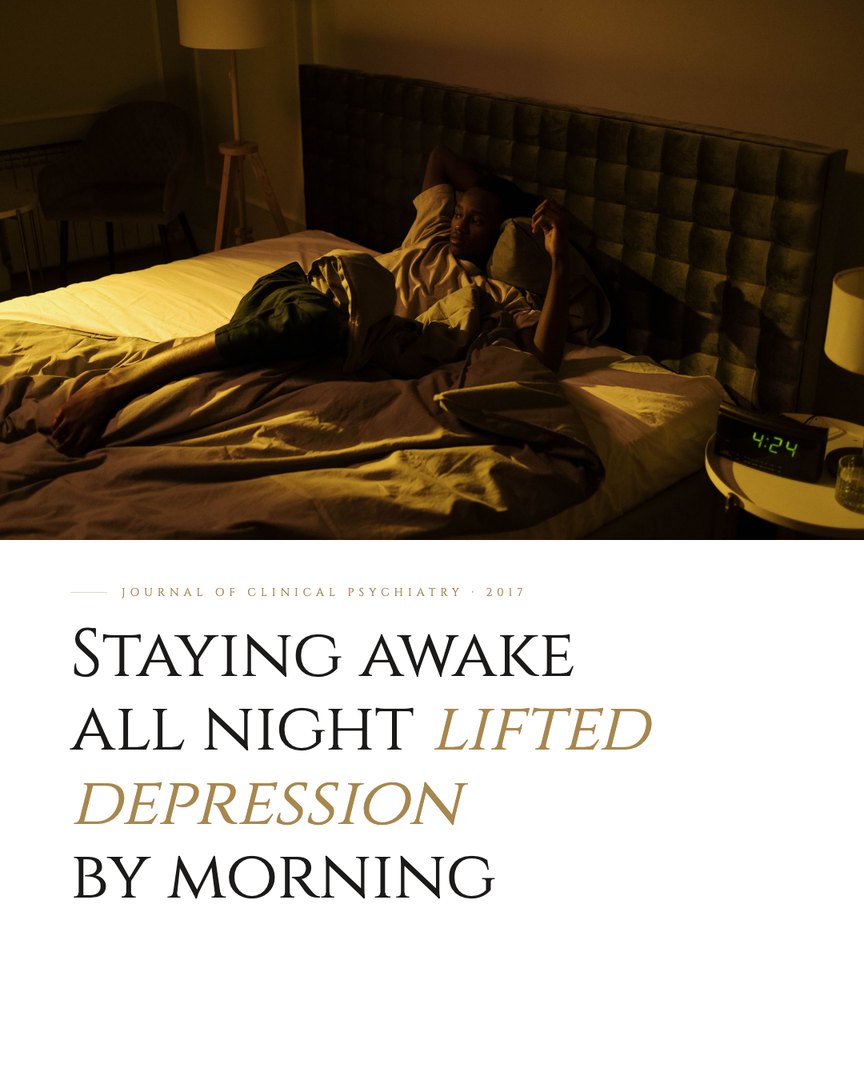
Researchers at the University of Pennsylvania combined results from 66 earlier studies on sleep deprivation therapy, a decades-old approach in which depressed patients are deliberately kept awake for a full night, sometimes two, under medical supervision.
Across the pooled studies, which ran from 1974 to 2016, about 50 percent of patients responded in studies without a control group, and about 45 percent in studies with a randomized control group, whether sleep loss was total or partial and regardless of age, sex or medication.
Roughly half of all patients improving overnight is a far higher response rate than most antidepressant drugs manage in the same span of time, though the lift often fades once a patient sleeps normally again, which is why the approach is usually paired with other treatments rather than used alone. The pattern rests on decades of smaller trials and case reports, not one large definitive study.
Read the original study
Boland et al., Journal of Clinical Psychiatry, 2017 · doi.org/10.4088/JCP.16r11332
One sleepless night, and the fog lifted.
Source
- Boland, E. M., Rao, H., Dinges, D. F., Smith, R. V., Goel, N., Detre, J. A., Basner, M., Sheline, Y. I., Thase, M. E., & Gehrman, P. R. (2017). Meta-Analysis of the Antidepressant Effects of Acute Sleep Deprivation. The Journal of Clinical Psychiatry, 78(8), e1020–e1034. https://doi.org/10.4088/JCP.16r11332