
Researchers at the University of California, Berkeley and Harvard Medical School scanned the brains of healthy volunteers while they viewed a series of increasingly disturbing images, comparing people who had slept normally against people who had been kept awake for roughly 35 hours straight beforehand.
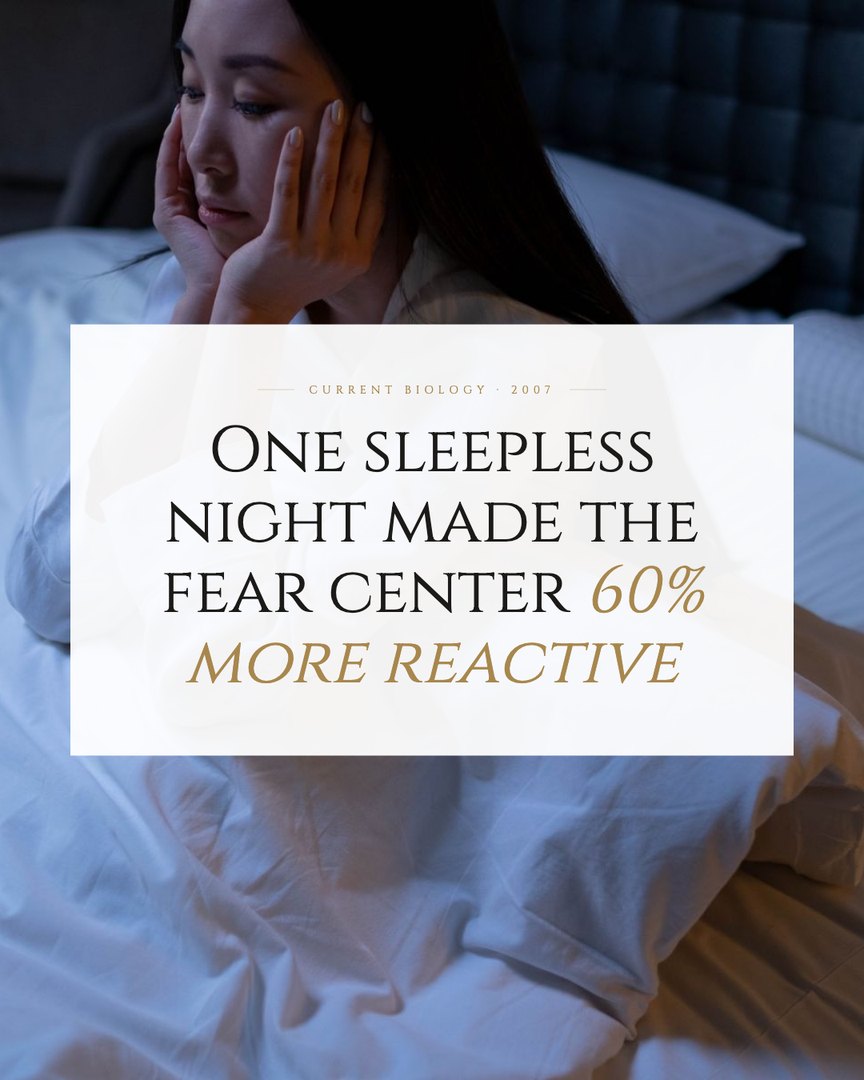
In the sleep-deprived group, the amygdala, the brain's primary fear and threat-detection center, showed roughly 60 percent more reactivity to the negative images than in the well-rested group. At the same time, the connection between the amygdala and the prefrontal cortex, the region that normally helps regulate emotional reactions, was substantially weaker after sleep loss.
The pattern suggested sleep loss does not simply make people tired, it loosens the brain's own regulatory brakes on fear and threat responses, leaving the amygdala to react with less oversight from higher brain regions. The study used one night of total sleep deprivation in healthy young adults, not repeated partial sleep loss, though later studies built directly on this result.
Read the original study
Yoo et al., Current Biology, 2007 · doi.org/10.1016/j.cub.2007.08.007
A sleepless night left fear running without its brakes.
Source
- Yoo, S.-S., Gujar, N., Hu, P., Jolesz, F. A., & Walker, M. P. (2007). The human emotional brain without sleep--a prefrontal amygdala disconnect. Current Biology, 17(20), R877–8. https://doi.org/10.1016/j.cub.2007.08.007