
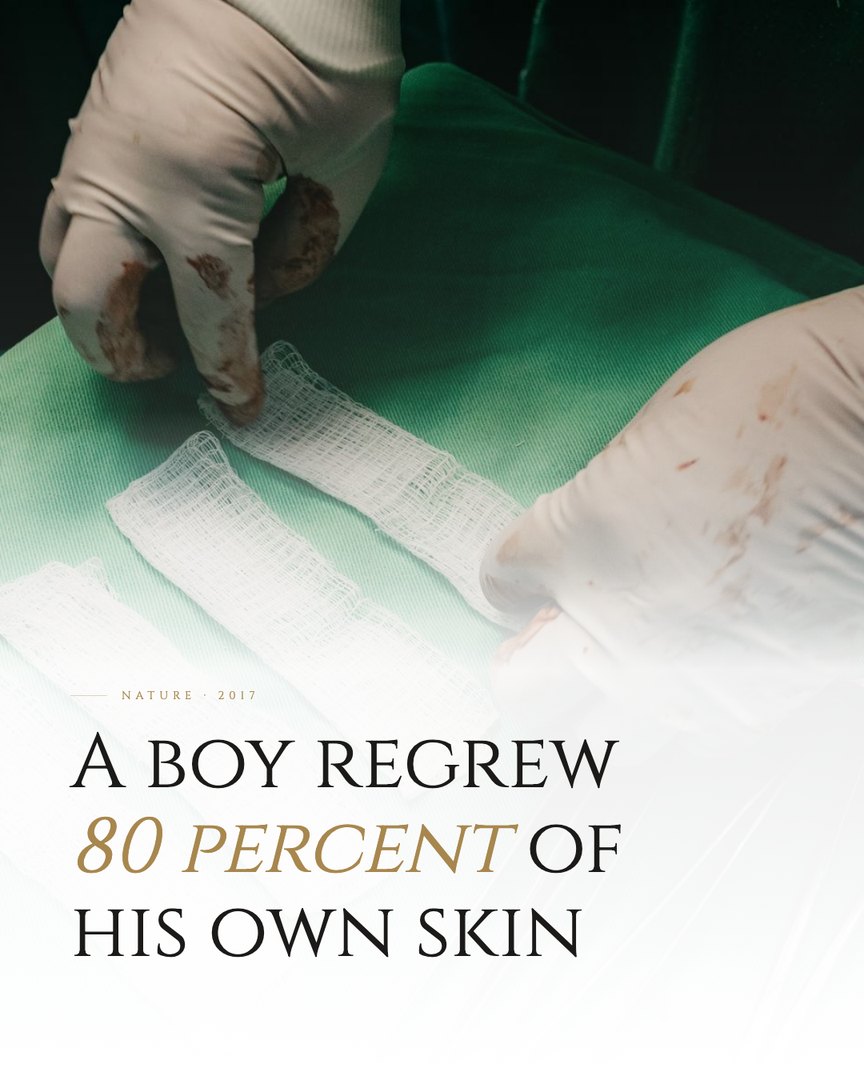
In 2015 a seven-year-old boy in Germany had lost most of his skin to infection and was not expected to survive, so his doctors turned to an experimental therapy built from his own genetically corrected stem cells.
Teams in Germany and at the University of Modena in Italy took a small patch of the boy's skin, corrected the faulty gene with a virus, grew the cells into sheets, and grafted them over multiple surgeries until roughly 80 percent of his body was covered in new, functional skin.
Years later the boy was reported to be living normally, with skin that healed and renewed like any other child's. But this was a single patient, treated under emergency compassionate-use circumstances, not a clinical trial, and the surgery and gene-correction process are complex enough that the approach is not routine treatment.
Read the original study
One patient, one new skin.
Source
- Hirsch, T., Rothoeft, T., Teig, N., Bauer, J. W., Pellegrini, G., De Rosa, L., Scaglione, D., Reichelt, J., Klausegger, A., Kneisz, D., Romano, O., Secone Seconetti, A., Contin, R., Enzo, E., Jurman, I., Carulli, S., Jacobsen, F., Luecke, T., Lehnhardt, M., . . . De Luca, M. (2017). Regeneration of the entire human epidermis using transgenic stem cells. Nature, 551(7680), 327–332. https://doi.org/10.1038/nature24487