
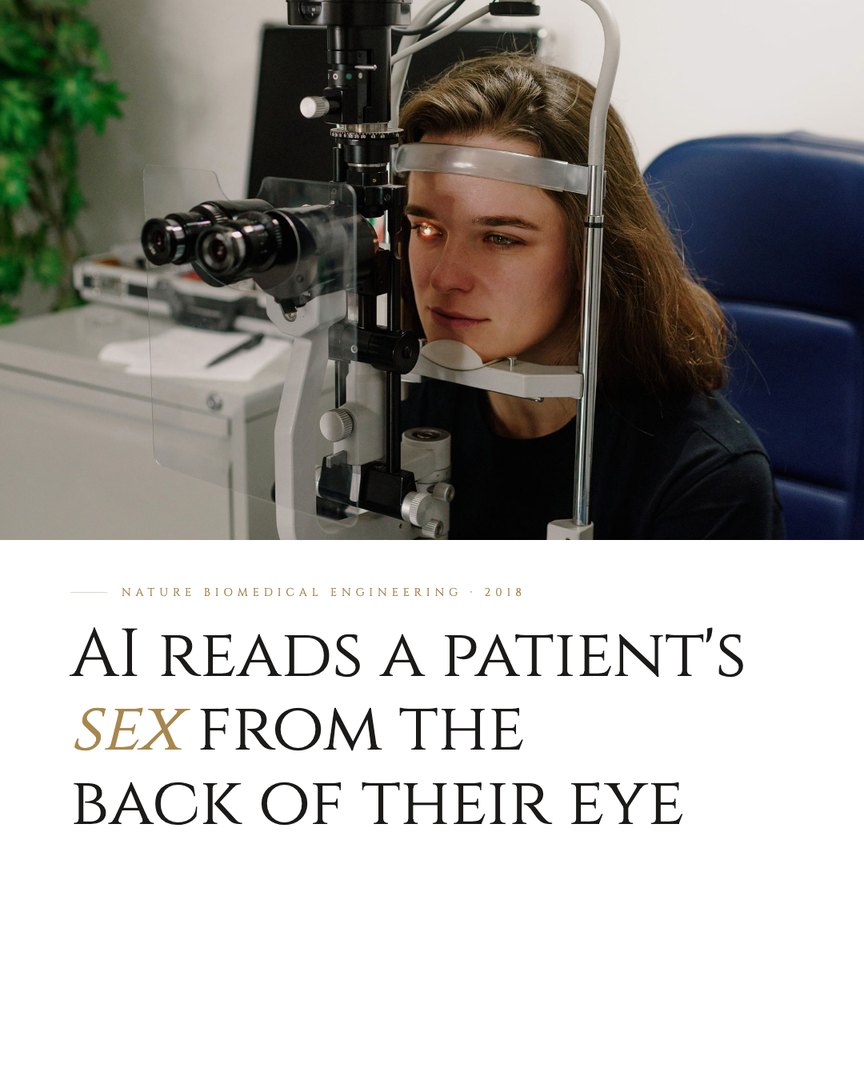
Researchers at Google trained a neural network on retinal photographs from over 280,000 patients, from UK Biobank and diabetic eye screening, originally just to see what else the images might be hiding about the rest of the body.
The network told male from female patients with an accuracy score of 0.97 out of 1 from the photograph alone, a distinction no ophthalmologist can make by eye. It also read age, blood pressure, and smoking status out of the same image.
Nobody had catalogued which retinal features differ by sex, so the team cannot yet say what the model is keying on, likely some combination of vessel pattern and optic disc shape too subtle for a person to name. The result reopened a basic question about how much systemic health information sits unread in a five-minute eye scan.
Read the original study
Poplin et al., Nature Biomedical Engineering, 2018 · doi.org/10.1038/s41551-018-0195-0
The eye had been keeping records nobody read.
Source
- Poplin, R., Varadarajan, A. V., Blumer, K., Liu, Y., McConnell, M. V., Corrado, G. S., Peng, L., & Webster, D. R. (2018). Prediction of cardiovascular risk factors from retinal fundus photographs via deep learning. Nature Biomedical Engineering, 2(3), 158–164. https://doi.org/10.1038/s41551-018-0195-0