
Researchers at Yale School of Public Health followed 3,635 adults over the age of 50 for up to 12 years, using a long-running national survey that asked people how many hours a week they spent reading books, newspapers or magazines.
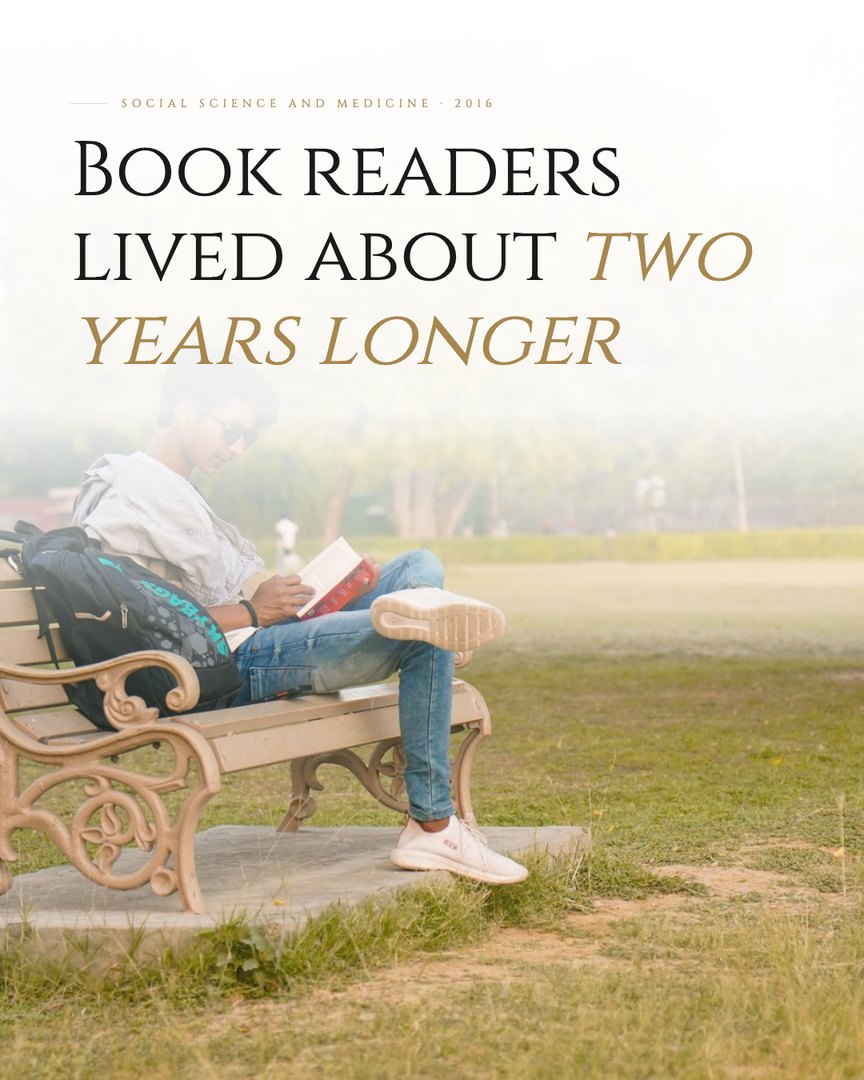
People who read books at all were about 20 percent less likely to die over the 12-year follow-up than people who read none, and in unadjusted data they had about 23 extra months of life at the point where 80 percent of each group survived.
The survival advantage held after the researchers accounted for education, income, health and other factors already known to affect lifespan, and it was noticeably larger for books than for reading newspapers or magazines by the same amount of time. The data is observational, drawn from a survey rather than an assigned experiment, so it cannot prove reading itself extends life, only that the two track together closely.
Read the original study
Bavishi, Slade and Levy, Social Science and Medicine, 2016 · doi.org/10.1016/j.socscimed.2016.07.014
A book, and about two more years.
Source
- Bavishi, A., Slade, M. D., & Levy, B. R. (2016). A chapter a day: Association of book reading with longevity. Social Science & Medicine, 164, 44–48. https://doi.org/10.1016/j.socscimed.2016.07.014