
The nonprofit APOPO trains giant African pouched rats to sniff out the smell of active tuberculosis infection. Researchers sent the rats back through thousands of sputum samples that clinic microscopy had already called negative.
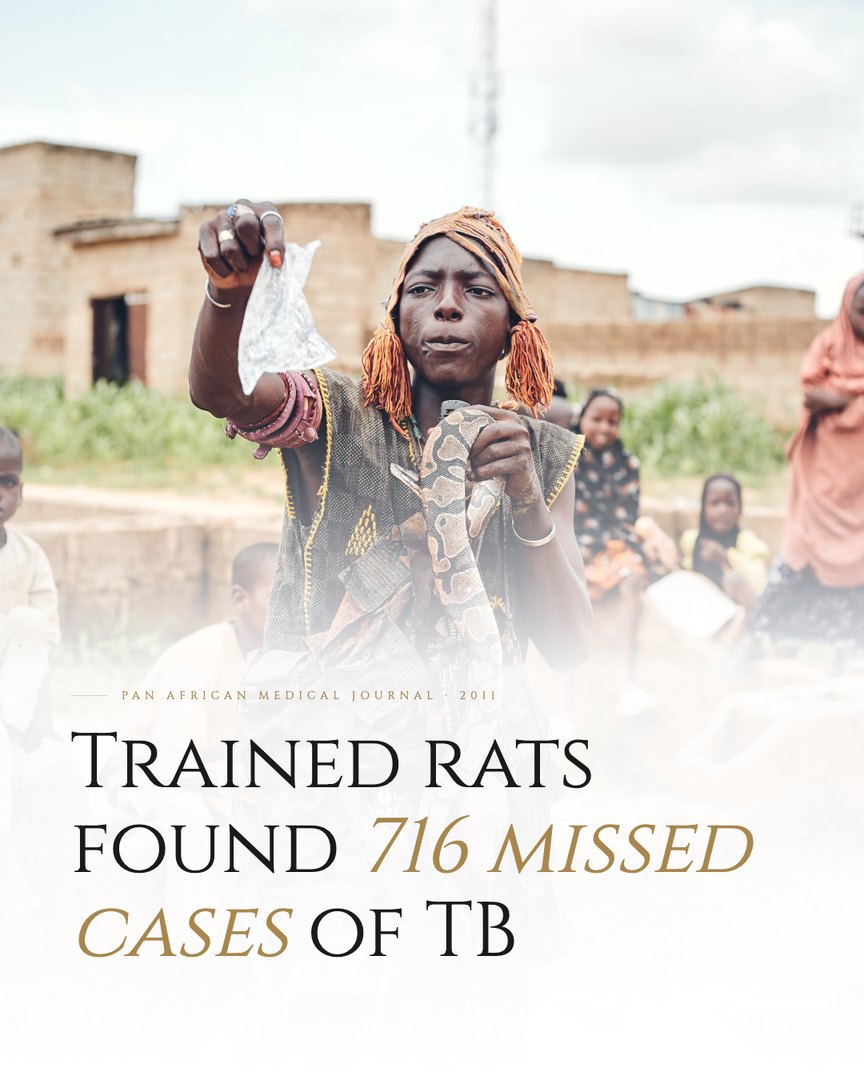
Across 26,665 samples from 12,329 patients, clinic microscopy alone had found 1,671 positive cases. The rats, screening the same samples a second time, flagged cases that lab microscopy then confirmed in 716 more people, a 42.8 percent increase in case detection.
This was described as a simulated second-line screening tool, layered on top of standard microscopy rather than replacing it, since rats cannot be deployed at the scale or speed of a lab test. Later APOPO studies extended the approach to pediatric samples, and the organization's rats are now used operationally across TB clinics in Tanzania and Mozambique as a low-cost add-on test.
Read the original study
Mahoney et al., Pan African Medical Journal, 2011 · doi.org/10.4314/pamj.v9i1.71204
A nose a lab test doesn't have.
Source
- Mahoney, A. M., Weetjens, B. J., Cox, C., Beyene, N., Mgode, G., Jubitana, M., Kuipers, D., Kazwala, R., Mfinanga, G. S., Durgin, A., & Poling, A. (2011). Using giant African pouched rats to detect tuberculosis in human sputum samples: 2010 findings. The Pan African Medical Journal, 9, 28. https://doi.org/10.4314/pamj.v9i1.71204