
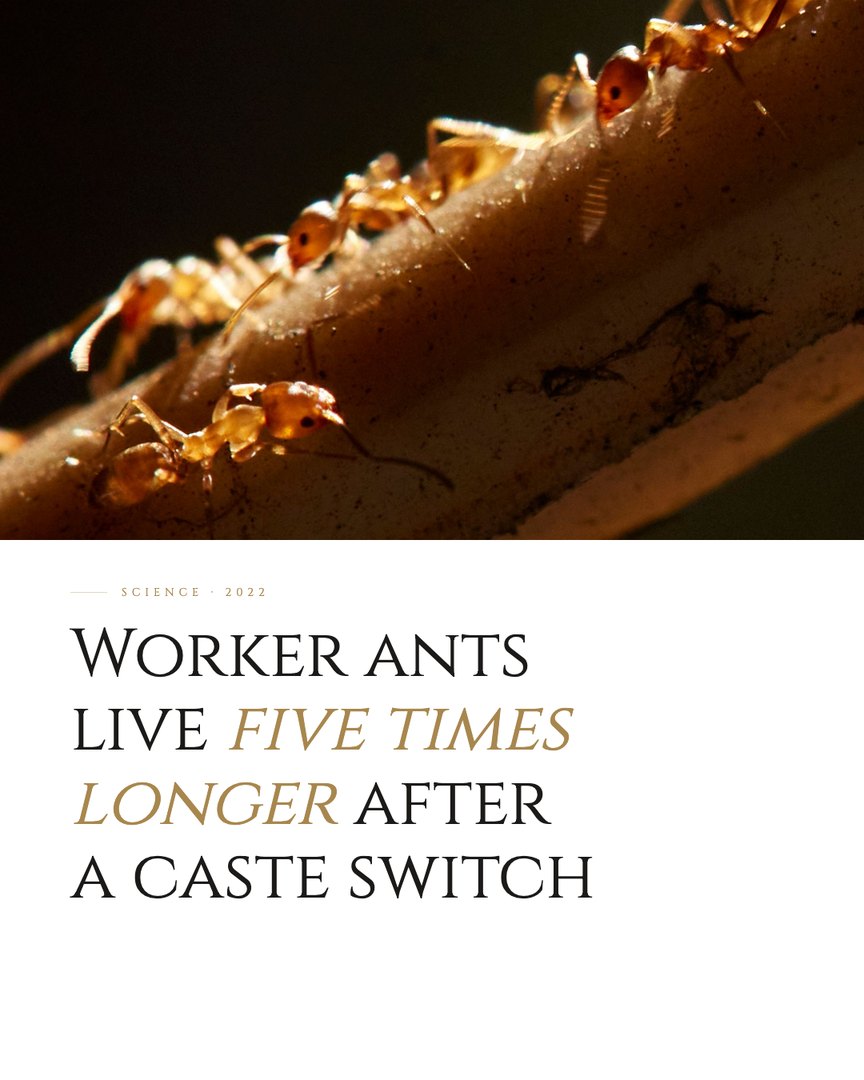
Researchers at New York University School of Medicine studied Harpegnathos saltator, a jumping ant species where, if the queen dies, an ordinary worker can transform into a reproductive pseudo-queen called a gamergate.
Gamergates were known to live about five times longer than ordinary workers, so the team compared gene activity before and after the switch. Insulin signaling rose sharply in the gamergate's brain, driving egg-related fat production, while a separate anti-insulin signal rose in the ovary, and that combination tracked with the extended lifespan.
Normally, more insulin signaling is linked to faster aging, so finding it alongside a longer life revealed a split pathway, one branch promoting reproduction and another, routed differently, suppressing the aging effects insulin usually carries elsewhere in the body. The ant offers a rare natural case where the usual trade-off between reproduction and longevity gets rewired rather than broken, though how that maps onto mammals is unknown.
Read the original study
A caste switch rewired the insulin-aging trade-off.
Source
- Yan, H., Opachaloemphan, C., Carmona-Aldana, F., Mancini, G., Mlejnek, J., Descostes, N., Sieriebriennikov, B., Leibholz, A., Zhou, X., Ding, L., Traficante, M., Desplan, C., & Reinberg, D. (2022). Insulin signaling in the long-lived reproductive caste of ants. Science, 377(6610), 1092–1099. https://doi.org/10.1126/science.abm8767