
Standard treatments combining counseling and medication typically help fewer than a third of smokers stay abstinent for six months. A small pilot study at Johns Hopkins University tested a very different approach: pairing smoking-cessation counseling with a few guided sessions of psilocybin, the psychoactive compound in certain mushrooms.
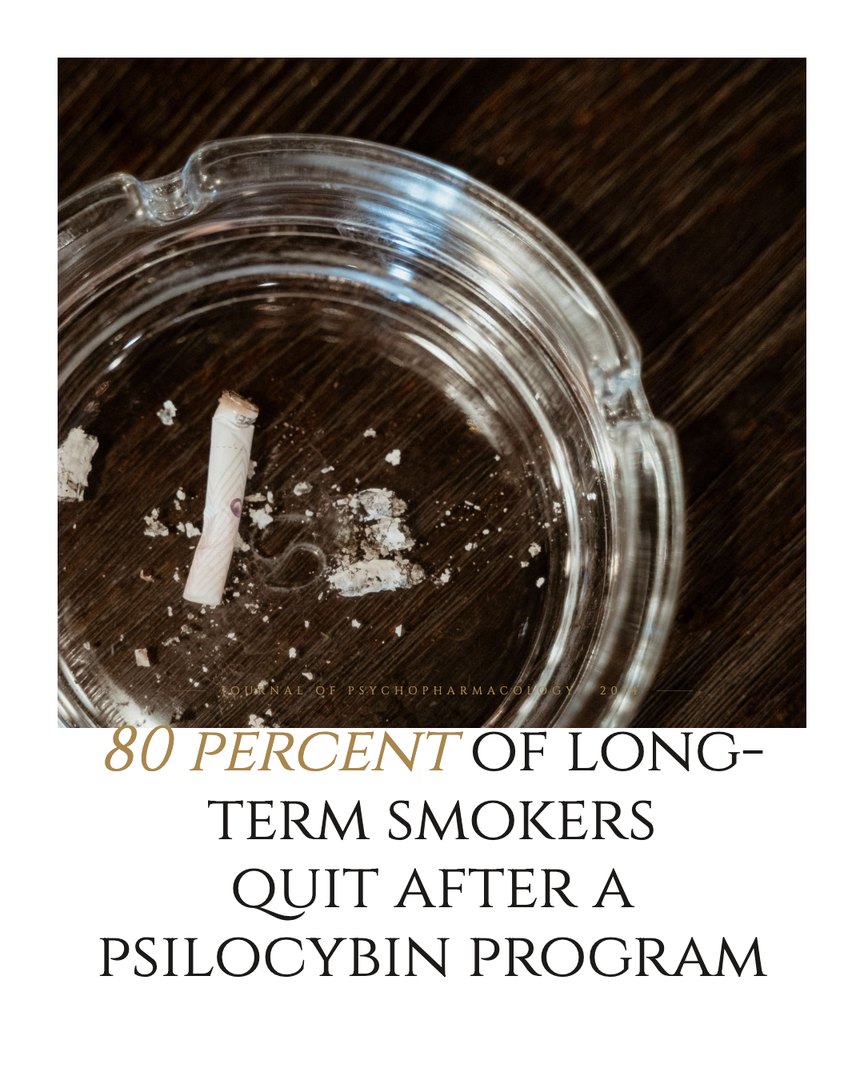
Researchers led by Matthew Johnson and Roland Griffiths at Johns Hopkins enrolled 15 long-term smokers, who averaged 19 years of daily smoking and multiple failed quit attempts, into a program combining cognitive behavioral therapy with two or three psilocybin sessions. At six months, 12 of the 15 participants, 80 percent, were confirmed abstinent through urine and breath tests.
That abstinence rate was far higher than typical six-month results for approved smoking treatments, which usually run below 35 percent. The study had no control group and only 15 participants from a single site, so researchers followed up: at roughly two and a half years, about 60 percent were still confirmed abstinent, and larger controlled trials are now underway to test the finding properly.
Read the original study
Johnson et al., Journal of Psychopharmacology, 2014 · doi.org/10.1177/0269881114548296
Fifteen smokers, one guided program, lasting results.
Source
- Johnson, M. W., Garcia-Romeu, A., Cosimano, M. P., & Griffiths, R. R. (2014). Pilot study of the 5-HT <sub>2A</sub> R agonist psilocybin in the treatment of tobacco addiction. Journal of Psychopharmacology, 28(11), 983–992. https://doi.org/10.1177/0269881114548296