
Researchers with the US Military HIV Research Program saw responses in HIV study cohorts that did not fit, using peptide sets from two custom suppliers.
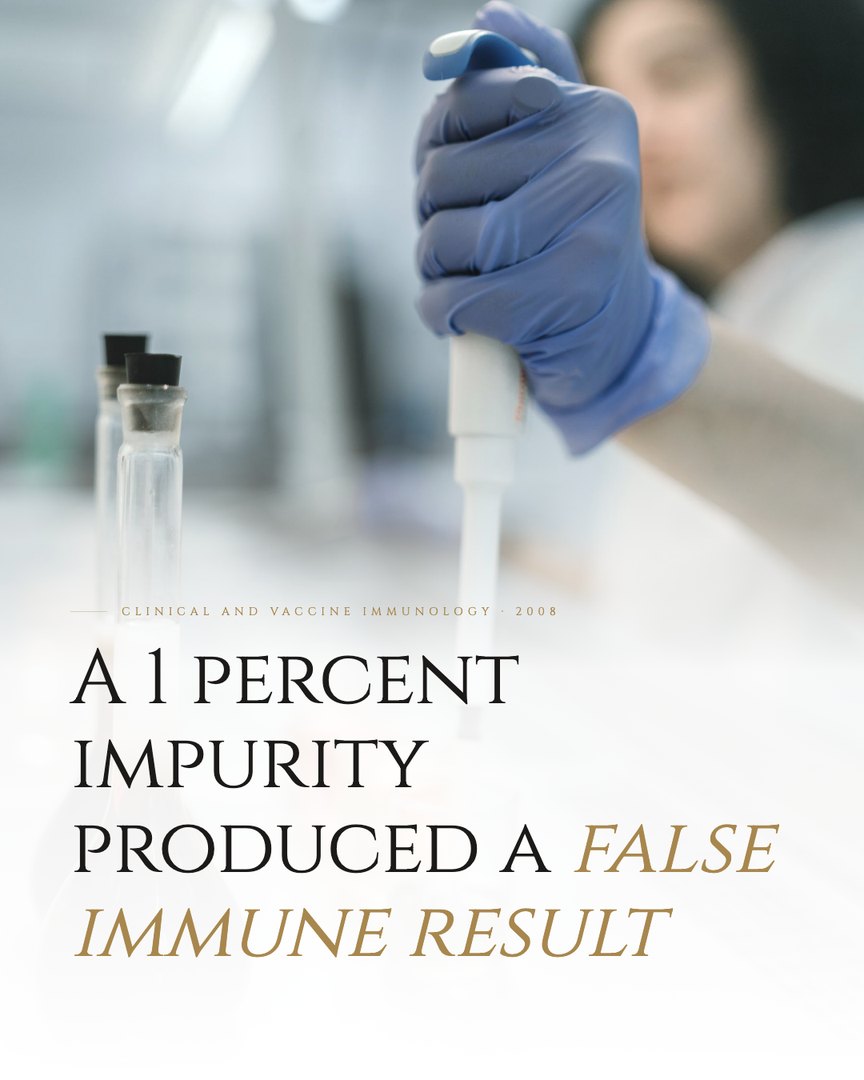
The responding T cells matched a cytomegalovirus peptide that is widely used in cellular immunology laboratories, not HIV. Analysis of the original HIV peptide stock found that cytomegalovirus peptide at about 1 percent by weight.
A peptide can be mostly the right sequence and still carry a small amount of something cells respond to strongly. A purity percentage says how much of a sample is the main product, not what the rest is. The authors proposed biological checks alongside chemical ones.
Read the original study
Currier et al., Clinical and Vaccine Immunology, 2008 · doi.org/10.1128/CVI.00284-07
The 1 percent decided the result.
Source
- Currier, J. R., Galley, L. M., Wenschuh, H., Morafo, V., Ratto-Kim, S., Gray, C. M., Maboko, L., Hoelscher, M., Marovich, M. A., & Cox, J. H. (2008). Peptide impurities in commercial synthetic peptides and their implications for vaccine trial assessment. Clinical and Vaccine Immunology, 15(2), 267–76. https://doi.org/10.1128/CVI.00284-07