
Researchers at the University of Exeter analyzed survey data from 19,806 people in England, comparing how many minutes a week they spent in parks, woods, or other natural spaces against how they rated their own health and wellbeing.
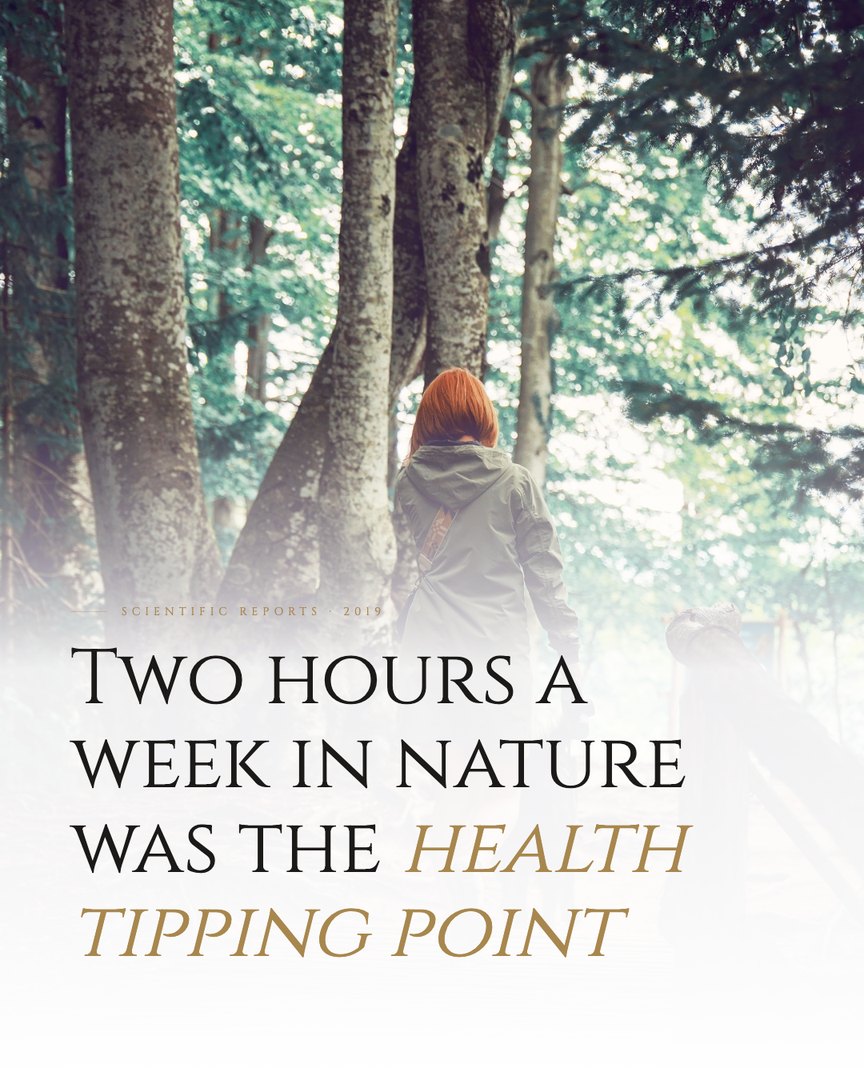
People who spent at least 120 minutes a week in nature were significantly more likely to report good health and high wellbeing than those who spent no time in nature that week, with benefits leveling off somewhere between 200 and 300 minutes a week and no further gains after that.
The pattern held across age, sex, occupational grade, area deprivation and long-term illness, and it did not matter much whether the 120 minutes came in one long outing or several shorter ones spread across the week. Because the data came from a survey at a single point in time, the study shows an association rather than proof that time in nature itself improves health.
Read the original study
White et al., Scientific Reports, 2019 · doi.org/10.1038/s41598-019-44097-3
Two hours outdoors, a measurable shift in wellbeing.
Source
- White, M. P., Alcock, I., Grellier, J., Wheeler, B. W., Hartig, T., Warber, S. L., Bone, A., Depledge, M. H., & Fleming, L. E. (2019). Spending at least 120 minutes a week in nature is associated with good health and wellbeing. Scientific Reports, 9(1), 7730. https://doi.org/10.1038/s41598-019-44097-3