
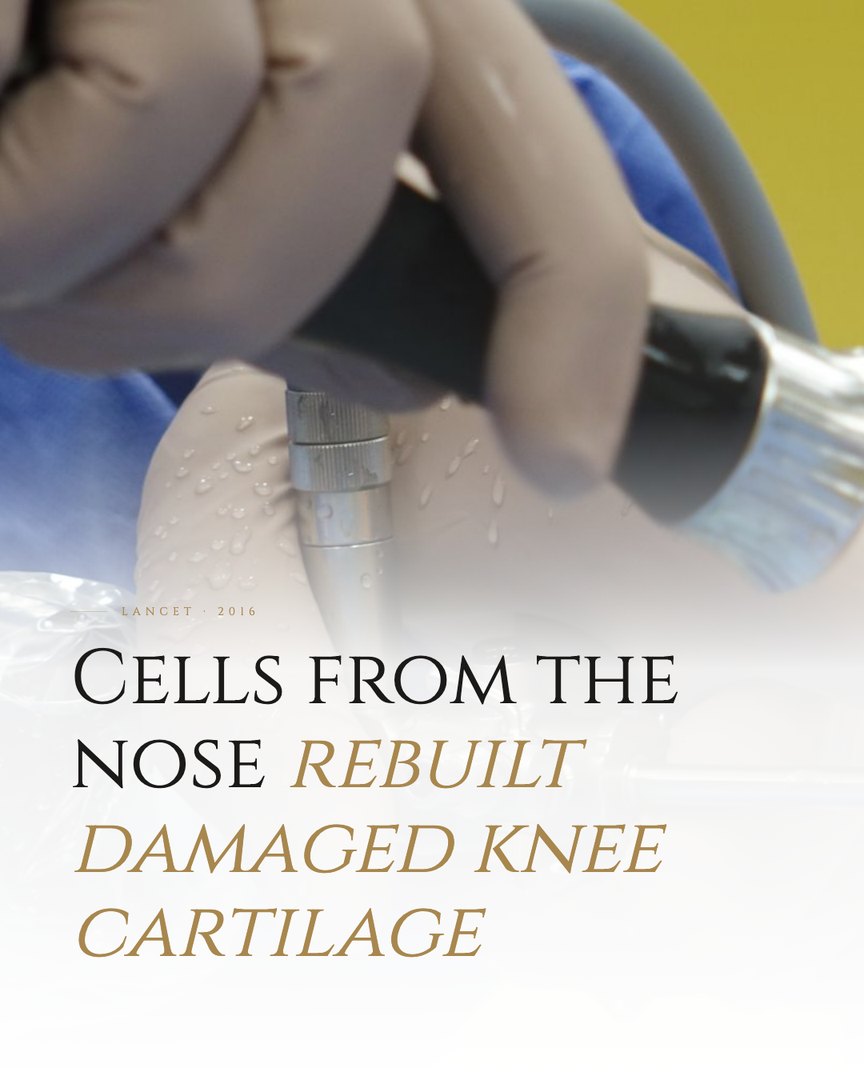
Surgeons at University Hospital Basel tried a different source of replacement tissue: cartilage-making cells taken from inside the nose, which grow faster in the lab than cells from an aging, damaged knee.
Ten adults with cartilage lesions up to 6 square centimeters received grafts grown from their own nasal cartilage cells, seeded onto a collagen membrane and implanted over the damaged area. Two years later, no graft had caused an adverse reaction, and pain, function, and quality-of-life scores had improved significantly from before surgery.
MRI scans showed the new tissue gradually taking on the look of the cartilage it replaced, though not a perfect match. The method avoids cutting healthy cartilage from elsewhere in the knee, the usual tradeoff of other cartilage repairs. Larger trials against standard treatment are still needed before it becomes routine.
Read the original study
Mumme et al., Lancet, 2016 · doi.org/10.1016/S0140-6736(16)31658-0
Nose cells, rebuilding a knee.
Source
- Mumme, M., Barbero, A., Miot, S., Wixmerten, A., Feliciano, S., Wolf, F., Asnaghi, A. M., Baumhoer, D., Bieri, O., Kretzschmar, M., Pagenstert, G., Haug, M., Schaefer, D. J., Martin, I., & Jakob, M. (2016). Nasal chondrocyte-based engineered autologous cartilage tissue for repair of articular cartilage defects: an observational first-in-human trial. The Lancet, 388(10055), 1985–1994. https://doi.org/10.1016/S0140-6736(16)31658-0