
Sanger Institute researchers in the 1000 Genomes Project sequenced the complete genomes of two family trios, each a mother, father, and child, to compare how many new mutations traced back to each parent.
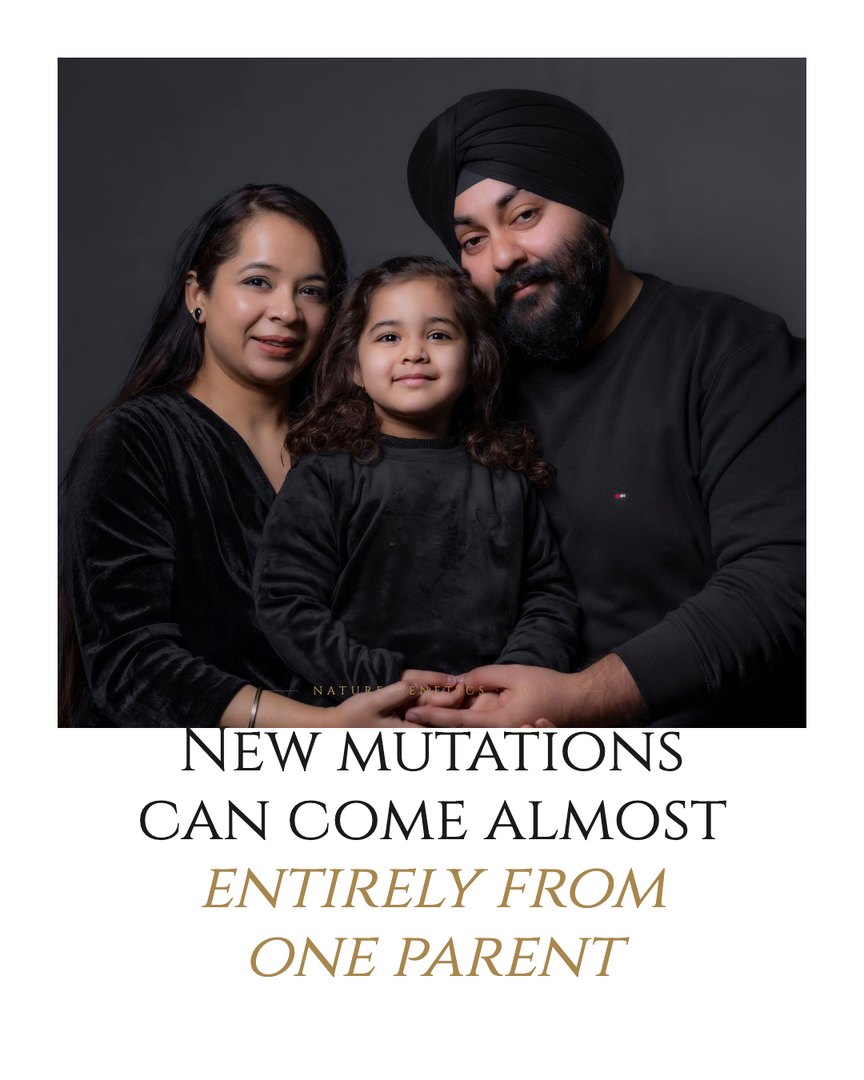
The two offspring carried 49 and 35 new mutations respectively that neither parent had. In one family, 92 percent of those new mutations came from the father, matching the long-standing assumption. In the other family, 64 percent came from the mother instead, reversing it entirely.
The old idea that fathers reliably contribute more new mutations turned out to hold in one family and fail in the other, revealing far more variation between families than anyone had measured directly before. With only two families studied, the range of normal variation is still not well mapped, and later, larger studies found most new mutations, about four in five, come from the father.
Read the original study
Conrad et al., Nature Genetics, 2011 · doi.org/10.1038/ng.862
One family's new mutations were mostly hers.
Source
- Conrad, D. F., Keebler, J. E. M., DePristo, M. A., Lindsay, S. J., Zhang, Y., Casals, F., Idaghdour, Y., Hartl, C. L., Torroja, C., Garimella, K. V., Zilversmit, M., Cartwright, R., Rouleau, G. A., Daly, M., Stone, E. A., Hurles, M. E., Awadalla, P., & 1000 Genomes Project (2011). Variation in genome-wide mutation rates within and between human families. Nature Genetics, 43(7), 712–4. https://doi.org/10.1038/ng.862