
Researchers at the Institute of Neuroscience in Shanghai modified the classic somatic cell nuclear transfer method, adding a drug and an enzyme to help the donor cell's genetic material reset properly inside a monkey egg, a step earlier primate cloning attempts had been missing.
Using cells from a fetal monkey, the team produced two healthy, identical long-tailed macaques, named Zhong Zhong and Hua Hua, from six attempted pregnancies. A second attempt using cells from an adult monkey produced two more clones, but both died shortly after birth, out of 22 attempted pregnancies.
The difference between the fetal-cell and adult-cell results showed that an older donor cell's genetic material is harder to reset for cloning, a limit that still applies in primates even with the improved method. The breakthrough was aimed at producing genetically uniform monkeys for biomedical research, not at normalizing primate cloning more broadly, and the overall success rate from pregnancy to healthy clone remained low.
Read the original study
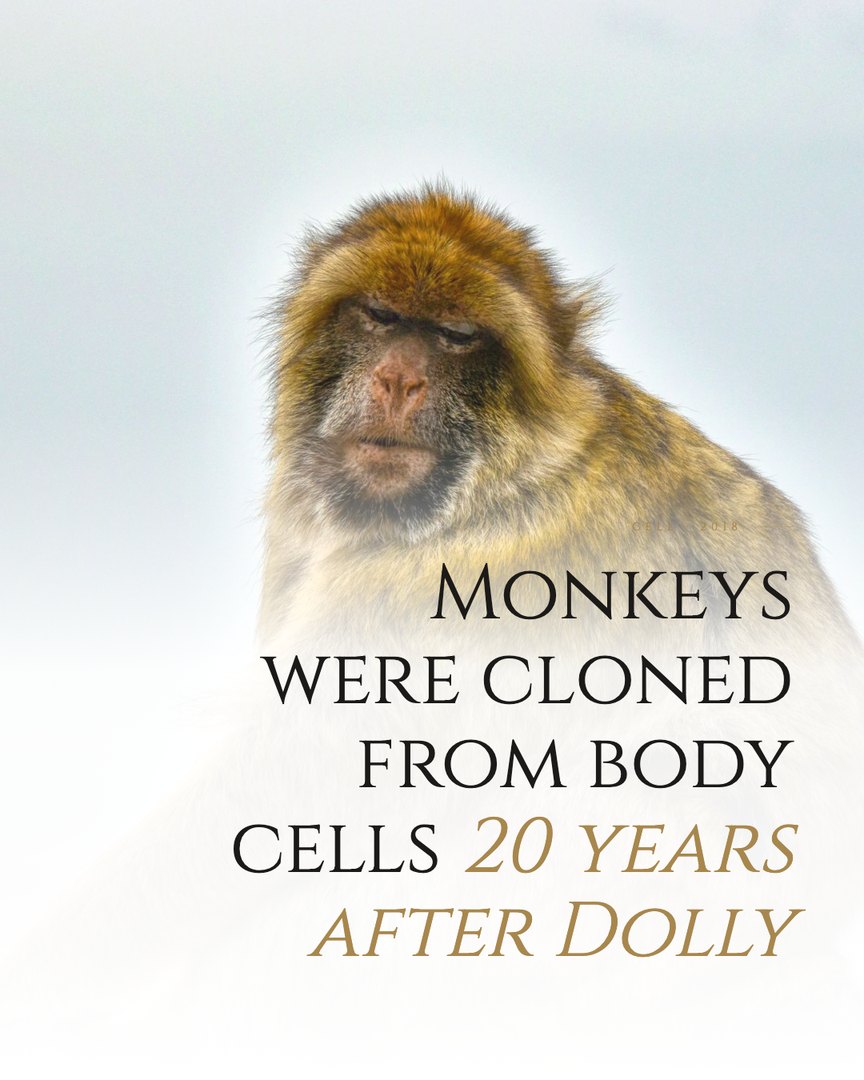
Two decades after Dolly, body-cell cloning reached primates.
Source
- Liu, Z., Cai, Y., Wang, Y., Nie, Y., Zhang, C., Xu, Y., Zhang, X., Lu, Y., Wang, Z., Poo, M., & Sun, Q. (2018). Cloning of Macaque Monkeys by Somatic Cell Nuclear Transfer. Cell, 172(4), 881–887.e7. https://doi.org/10.1016/j.cell.2018.01.020