
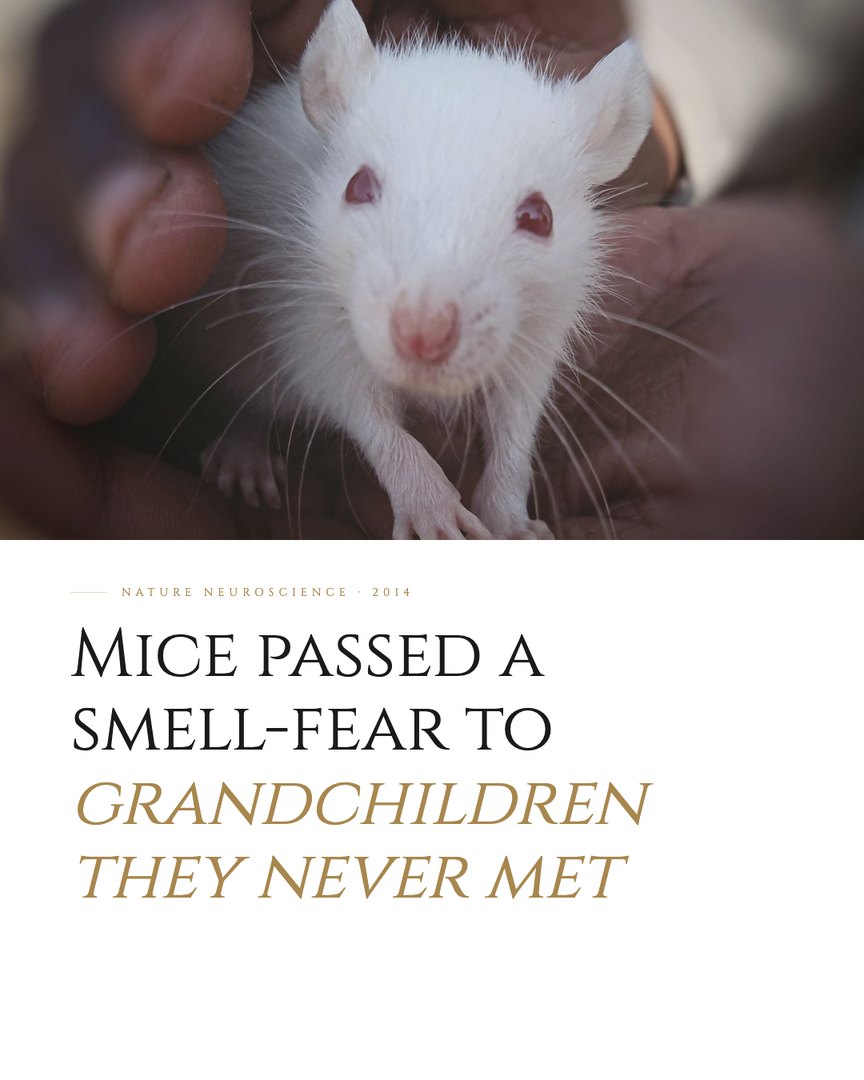
Researchers at Emory University trained male mice to fear a specific odor by pairing it with a mild shock, then bred them and looked for the fear in offspring who had never smelled the odor or met their father.
Both the children and grandchildren of the trained mice flinched at the odor they had never encountered, and showed more sensitive neurons tuned to detect it. Sperm from the trained males carried altered methylation on the gene for that odor's receptor, a chemical mark that can change gene activity without changing the DNA sequence itself.
The result suggested that a frightening experience could leave a trace in sperm that shaped a grandchild's brain before it was born. The mechanism remains debated, since few labs have replicated transgenerational effects of this kind in mammals, and how the mark survives reprogramming in the embryo is still not fully explained.
Read the original study
Dias and Ressler, Nature Neuroscience, 2014 · doi.org/10.1038/nn.3594
A fear the grandchildren never learned themselves.
Source
- Dias, B. G., & Ressler, K. J. (2014). Parental olfactory experience influences behavior and neural structure in subsequent generations. Nature Neuroscience, 17(1), 89–96. https://doi.org/10.1038/nn.3594