
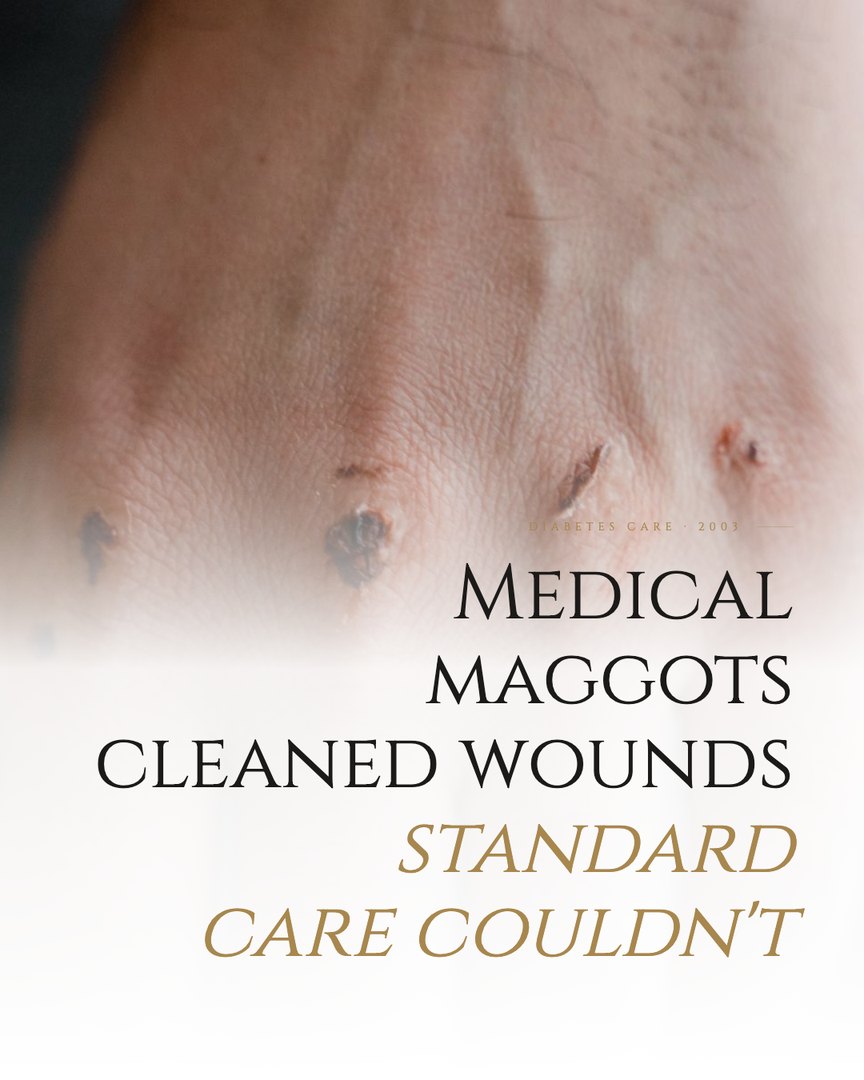
Ronald Sherman at the VA Medical Center in Long Beach and UC Irvine reviewed records of veterans with these nonhealing wounds, comparing standard debridement against sterile fly larvae placed directly onto the dead tissue.
Across 20 wounds in 18 patients, maggot therapy cleared an average of 4.1 square centimeters of dead tissue in two weeks, while conventional treatment removed almost none in the same period. By four weeks, every maggot-treated wound was fully debrided, while after five weeks conventional wounds still carried dead tissue over a third of their surface.
Maggots feed on dead tissue but leave living tissue alone, and they secrete enzymes and antimicrobial compounds that help clean infected wounds in ways scalpel debridement and antibiotics cannot always match. The FDA cleared sterile medical maggots as a prescription medical device in 2004, and the therapy is now a recognized option for chronic wounds that have stopped responding to everything else.
Read the original study
Sherman, Diabetes Care, 2003 · doi.org/10.2337/diacare.26.2.446
Nature's debridement, cleared by the FDA.
Source
- Sherman, R. A. (2003). Maggot therapy for treating diabetic foot ulcers unresponsive to conventional therapy. Diabetes Care, 26(2), 446–51. https://doi.org/10.2337/diacare.26.2.446