
A team led by researchers at the University of Pennsylvania built a deep learning model called APEX and mined the reconstructed proteomes of extinct species, searching more than 10 million protein fragments for ones that looked like they could kill bacteria.
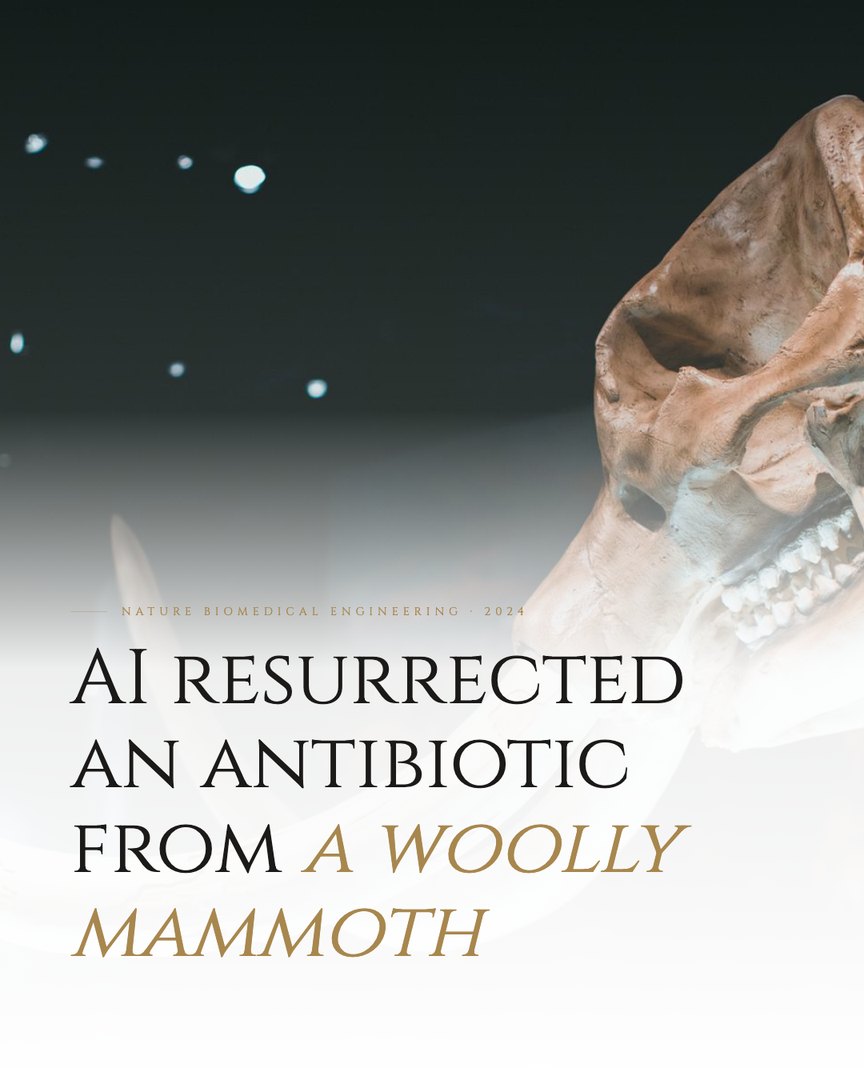
The model flagged over 37,000 candidate sequences. Among the molecules the team tested in mice, one named after the woolly mammoth and others drawn from the extinct giant sloth, the ancient sea cow, and the giant elk reduced skin or thigh infections, built from proteins last alive thousands to millions of years ago.
The same lab had already pulled a related peptide from Neanderthal and Denisovan proteins a year earlier, naming one candidate Neanderthalin-1. None of this is folk resurrection; it is pattern-matching across long-dead genomes for sequences modern chemistry can simply synthesize and test. The compounds are early and mouse-only, but the approach turned extinction itself into a drug-discovery database.
Read the original study
Wan et al., Nature Biomedical Engineering, 2024 · doi.org/10.1038/s41551-024-01201-x
Gone for millennia, still able to fight an infection.
Source
- Wan, F., Torres, M. D. T., Peng, J., & de la Fuente-Nunez, C. (2024). Deep-learning-enabled antibiotic discovery through molecular de-extinction. Nature Biomedical Engineering, 8(7), 854–871. https://doi.org/10.1038/s41551-024-01201-x