
Researchers at Northwestern University had 20 healthy young adults sleep a first night in near darkness. Half then slept a second night under overhead room light, and the team measured their heart activity overnight and insulin sensitivity the next morning.
On the night with light left on, participants showed a higher heart rate and lower heart rate variability while asleep, a sign of the body's stress response staying more active than usual, and the next morning their insulin resistance was measurably higher, while a group kept in near darkness both nights showed no such change.
The team pointed to the sympathetic nervous system, the body's fight-or-flight circuitry, as the likely link between light exposure and the metabolic change, staying more active overnight even while a person is unaware of the light and fully asleep. The study covered one night per condition in a small group of healthy adults, so it shows a fast, reversible shift rather than a verdict on long-term light exposure during sleep.
Read the original study
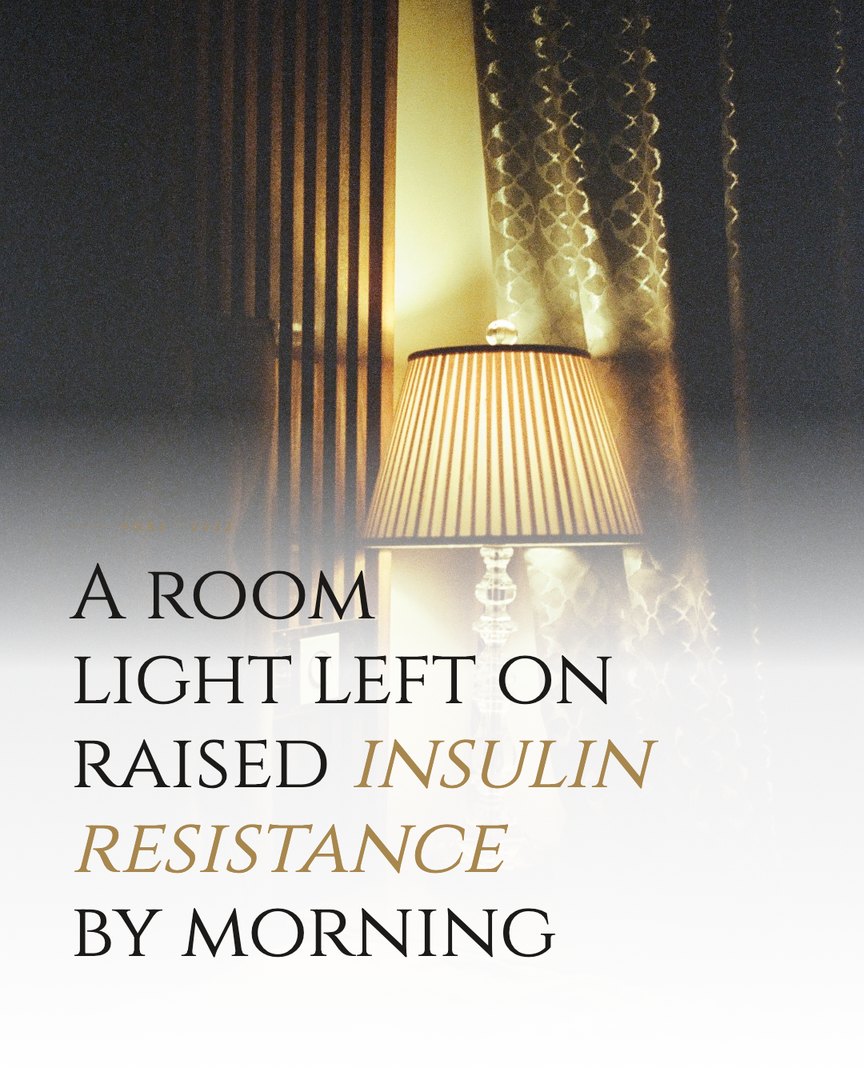
A lamp left on, and blood sugar shifted.
Source
- Mason, I. C., Grimaldi, D., Reid, K. J., Warlick, C. D., Malkani, R. G., Abbott, S. M., & Zee, P. C. (2022). Light exposure during sleep impairs cardiometabolic function. Proceedings of the National Academy of Sciences of the United States of America, 119(12), e2113290119. https://doi.org/10.1073/pnas.2113290119