
Researchers at the Max Planck Institute for Biology of Ageing in Cologne wanted to know whether an aging gut microbiome was just a symptom of the fish growing old, or something actively shortening its life.
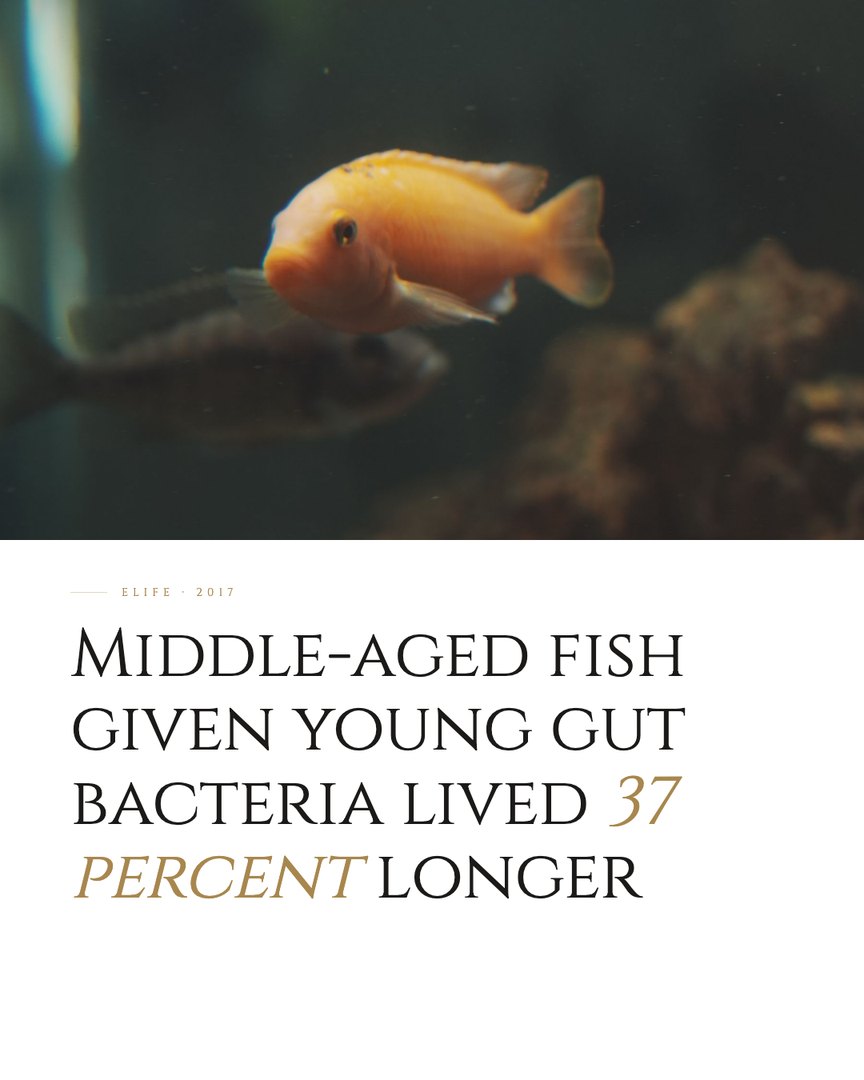
The team took middle-aged killifish and recolonized their guts with bacteria drawn from young donor fish. Fish that received the young microbiota lived 37 percent longer in median lifespan than untreated fish, 41 percent longer than fish given middle-aged donor bacteria, and their decline in movement and exploration was delayed.
The transplant also kept the gut's bacterial diversity high, preventing the decline normally seen with age, and certain bacterial genera were overrepresented in the longest-lived fish. The result showed that an aging gut community is not a passive bystander but something that can be reset, at least in a short-lived vertebrate. Whether the same swap would help a longer-lived animal is still unknown.
Read the original study
Young gut bacteria, an old fish's second act.
Source
- Smith, P., Willemsen, D., Popkes, M., Metge, F., Gandiwa, E., Reichard, M., & Valenzano, D. R. (2017). Regulation of life span by the gut microbiota in the short-lived African turquoise killifish. ELife, 6. https://doi.org/10.7554/eLife.27014