
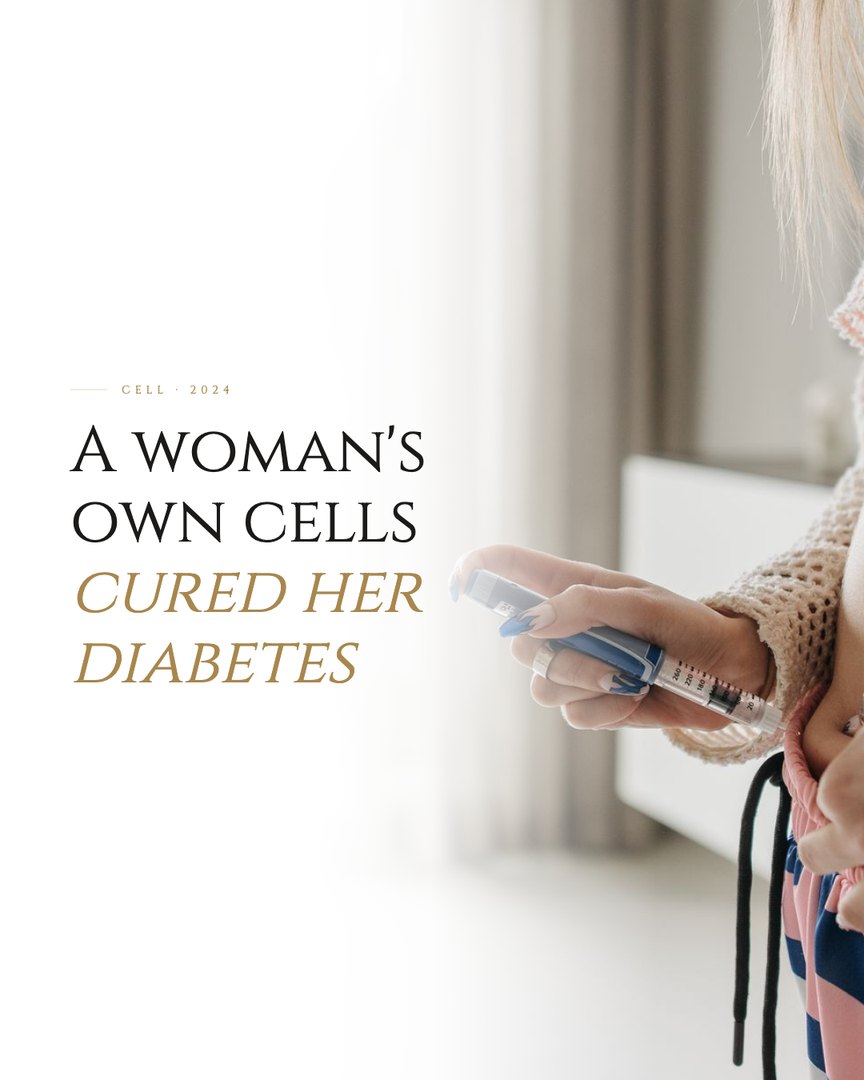
Researchers in Shanghai took fat cells from the woman, chemically reprogrammed them into stem cells over 59 days, then coaxed those stem cells into insulin-producing islet cells and transplanted them into her abdominal muscle wall.
Within about two and a half months of the transplant, the woman was making enough of her own insulin to stop insulin injections entirely. At one year, she remained off insulin, with normal blood sugar control on standard testing and no tumor formation at the transplant site.
Because the islet cells were grown from her own tissue rather than a donor's, there was no need for the immune-suppressing drugs that organ and islet transplants normally require. This was a single patient in an early-stage trial, so it does not yet show how many other patients would respond the same way or how long the effect lasts, and larger trials are now underway.
Read the original study
Wang et al., Cell, 2024 · doi.org/10.1016/j.cell.2024.09.004
Her own fat became her new pancreas.
Source
- Wang, S., Du, Y., Zhang, B., Meng, G., Liu, Z., Liew, S. Y., Liang, R., Zhang, Z., Cai, X., Wu, S., Gao, W., Zhuang, D., Zou, J., Huang, H., Wang, M., Wang, X., Wang, X., Liang, T., Liu, T., . . . Shen, Z. (2024). Transplantation of chemically induced pluripotent stem-cell-derived islets under abdominal anterior rectus sheath in a type 1 diabetes patient. Cell, 187(22), 6152–6164.e18. https://doi.org/10.1016/j.cell.2024.09.004