
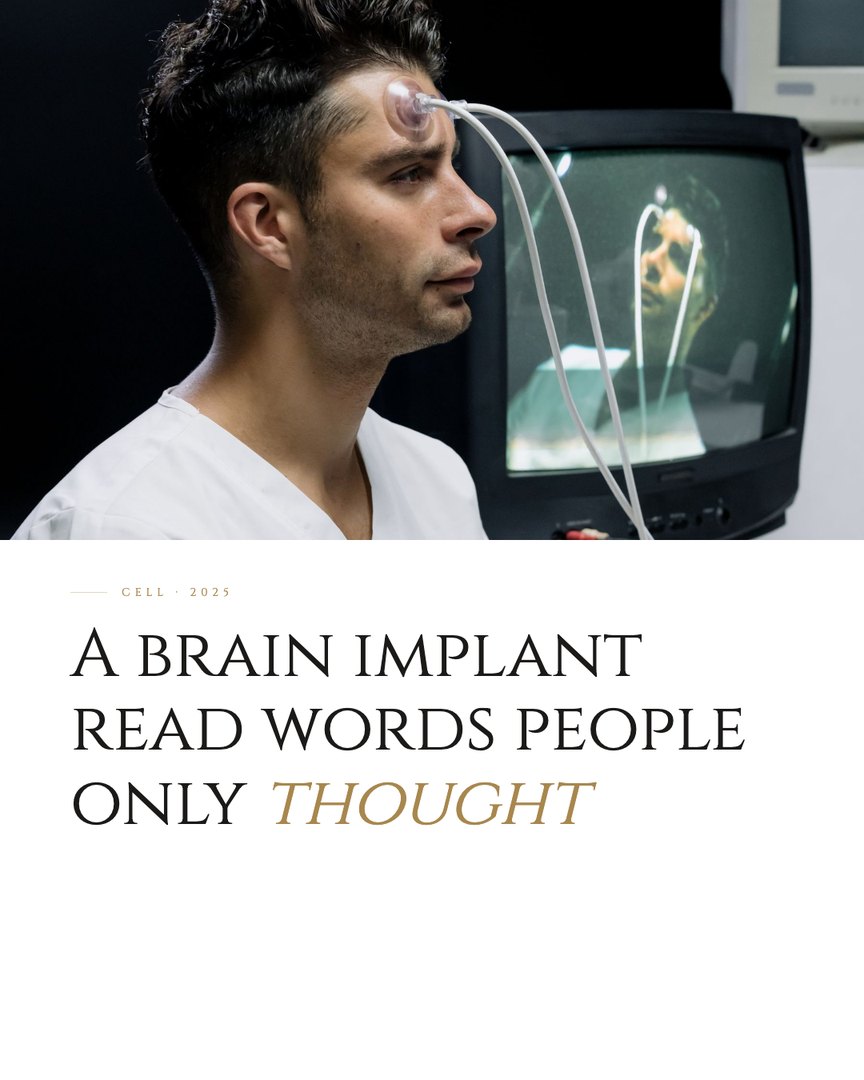
Researchers at Stanford University recorded from microelectrodes implanted in the motor cortex of four people paralyzed by ALS or a brainstem stroke, comparing brain activity when they attempted to speak versus when they only imagined saying the words.
Inner speech, never spoken or attempted aloud, activated the same brain region with a weaker version of the same pattern, and a decoder trained to read it reached up to 74 percent accuracy translating imagined sentences into text, recognizing a vocabulary of up to 125,000 words.
Because inner speech and private thought share brain machinery, the team built a decoder that ignores inner speech by default and only translates it after the user imagines an unlock phrase, catching that phrase correctly more than 98 percent of the time, to avoid broadcasting thoughts the user never meant to share. The system has only been tested in four participants with electrodes already implanted.
Read the original study
Kunz et al., Cell, 2025 · doi.org/10.1016/j.cell.2025.06.015
A thought never spoken still reached the page.
Source
- Kunz, E. M., Abramovich Krasa, B., Kamdar, F., Avansino, D. T., Hahn, N., Yoon, S., Singh, A., Nason-Tomaszewski, S. R., Card, N. S., Jude, J. J., Jacques, B. G., Bechefsky, P. H., Iacobacci, C., Hochberg, L. R., Rubin, D. B., Williams, Z. M., Brandman, D. M., Stavisky, S. D., AuYong, N., . . . Willett, F. R. (2025). Inner speech in motor cortex and implications for speech neuroprostheses. Cell, 188(17), 4658–4673.e17. https://doi.org/10.1016/j.cell.2025.06.015