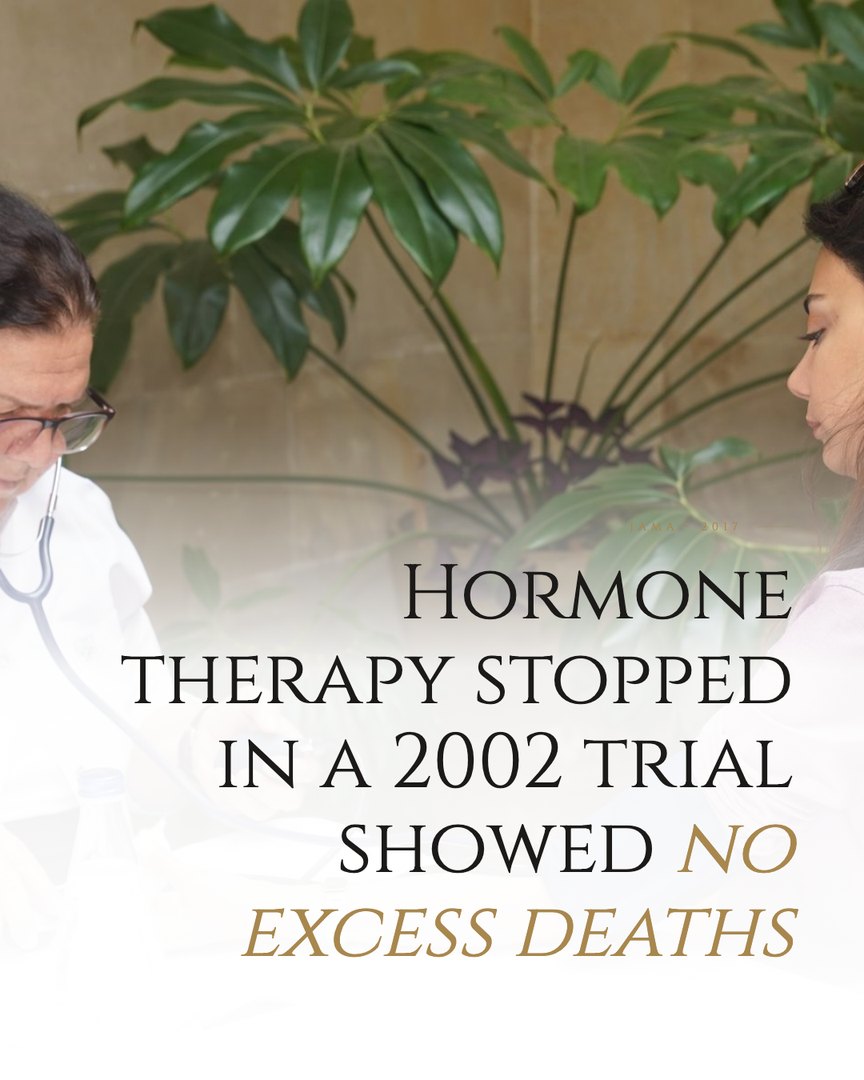
Researchers at Brigham and Women's Hospital and Harvard Medical School followed 27,347 women from that same trial for 18 years and found no increase in deaths from any cause among those who had taken hormone therapy.
JoAnn Manson's team tracked all-cause, cardiovascular, and cancer mortality in women randomized to estrogen alone, estrogen plus progestin, or placebo in the Women's Health Initiative. All-cause mortality came out nearly identical, 27.1 percent on hormone therapy versus 27.6 percent on placebo, across more than 7,400 deaths over the full follow-up.
The 2002 combined-hormone arm stopped early over a short-term risk of breast cancer, stroke, and blood clots, concerns still factored into current guidance. This follow-up addressed a separate, broader fear that took hold afterward, that the drugs would shorten lives overall, and found that fear unsupported after tracking women for nearly two decades.
Read the original study
The long-term death toll never showed up.
Source
- Manson, J. E., Aragaki, A. K., Rossouw, J. E., Anderson, G. L., Prentice, R. L., LaCroix, A. Z., Chlebowski, R. T., Howard, B. V., Thomson, C. A., Margolis, K. L., Lewis, C. E., Stefanick, M. L., Jackson, R. D., Johnson, K. C., Martin, L. W., Shumaker, S. A., Espeland, M. A., Wactawski-Wende, J., & for the WHI Investigators (2017). Menopausal Hormone Therapy and Long-term All-Cause and Cause-Specific Mortality. JAMA, 318(10), 927. https://doi.org/10.1001/jama.2017.11217