
Researchers at Hunter College measured exactly how many calories 30 Hadza adults burned in a day, using doubly labeled water, a tracer method that captures total energy expenditure with precision, rather than relying on step counts or guesses.
After adjusting for body size, the Hadza burned about the same number of calories per day as sedentary adults in the United States and Europe, despite covering far more ground on foot. The metabolic cost of walking and resting was also nearly identical between the two groups.
The finding challenged the assumption that total daily energy expenditure rises in step with physical activity. Pontzer's team proposed instead that the body compensates, trimming energy spent on other processes when activity goes up, which later research in other populations has supported and which helps explain why exercise programs often produce less weight loss than simple calorie math predicts.
Read the original study
Pontzer et al., PLoS ONE, 2012 · doi.org/10.1371/journal.pone.0040503
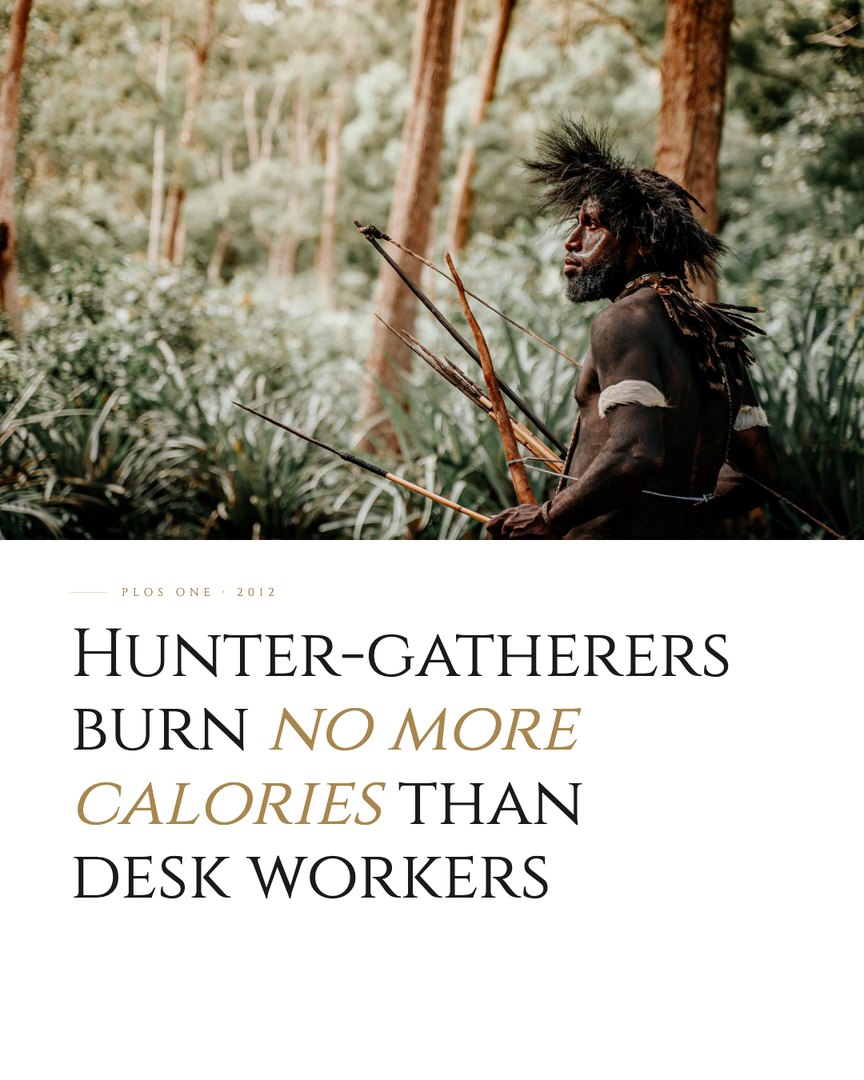
More walking did not mean more calories burned.
Source
- Pontzer, H., Raichlen, D. A., Wood, B. M., Mabulla, A. Z. P., Racette, S. B., & Marlowe, F. W. (2012). Hunter-Gatherer Energetics and Human Obesity. PLoS ONE, 7(7), e40503. https://doi.org/10.1371/journal.pone.0040503