
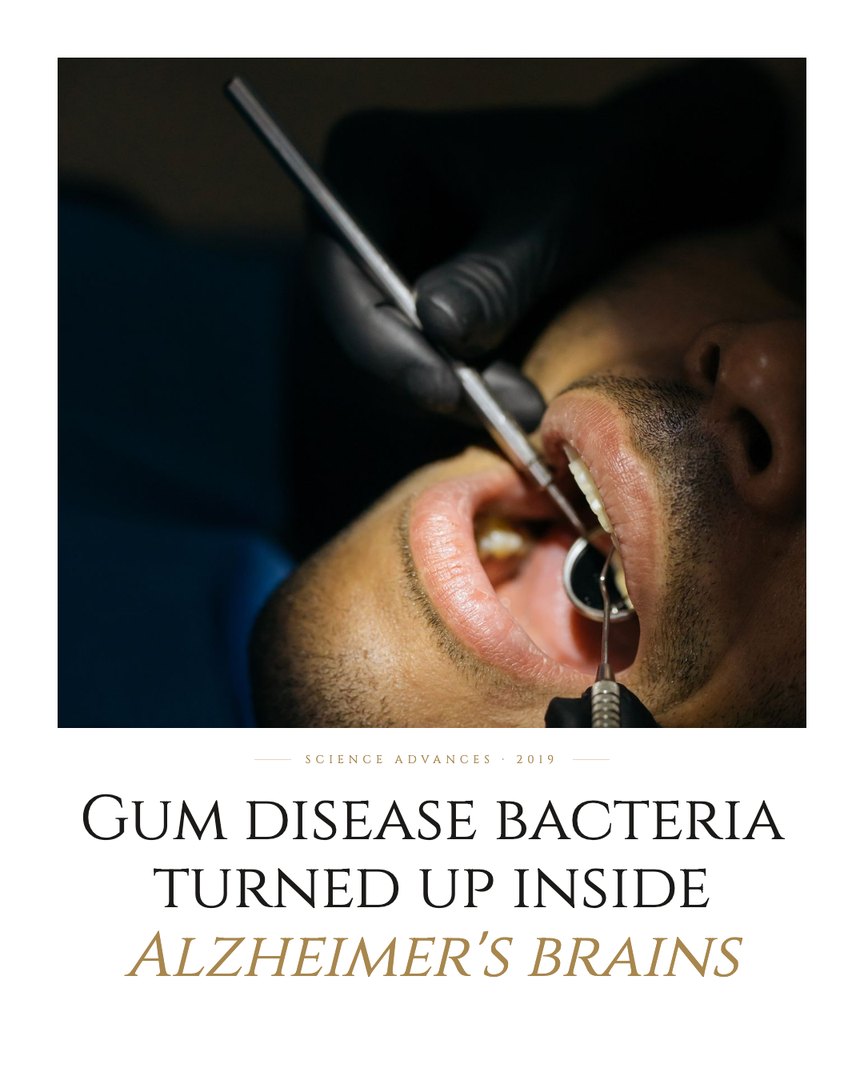
A team including researchers from Cortexyme and Jagiellonian University looked instead at a bacterium best known for causing gum disease, testing whether it could reach the brain and leave a trace in people who had died with Alzheimer's.
In autopsied brain tissue from people with Alzheimer's, the team found Porphyromonas gingivalis and its toxic enzymes, called gingipains, at levels that correlated with tau and ubiquitin pathology in the same brains. In mice, oral infection with the same bacterium led to it colonizing the brain and raising amyloid production.
An experimental drug blocking the bacterium's toxic enzymes reduced brain infection, lowered amyloid, calmed inflammation, and protected neurons in infected mice, and the company behind the finding later tested a version of that drug in a human Alzheimer's trial, which did not meet its goals. The mouse and tissue findings do not establish that gum bacteria cause Alzheimer's in people, only that they turn up where the disease does.
Read the original study
Dominy et al., Science Advances, 2019 · doi.org/10.1126/sciadv.aau3333
A mouth bacterium, found where it shouldn't be.
Source
- Dominy, S. S., Lynch, C., Ermini, F., Benedyk, M., Marczyk, A., Konradi, A., Nguyen, M., Haditsch, U., Raha, D., Griffin, C., Holsinger, L. J., Arastu-Kapur, S., Kaba, S., Lee, A., Ryder, M. I., Potempa, B., Mydel, P., Hellvard, A., Adamowicz, K., . . . Potempa, J. (2019). Porphyromonas gingivalis in Alzheimer's disease brains: Evidence for disease causation and treatment with small-molecule inhibitors. Science Advances, 5(1), eaau3333. https://doi.org/10.1126/sciadv.aau3333