
The Prospective Urban Rural Epidemiology study, led from McMaster University, measured grip strength with a simple handheld dynamometer in more than 140,000 adults across 17 countries, then tracked who survived over the following years.
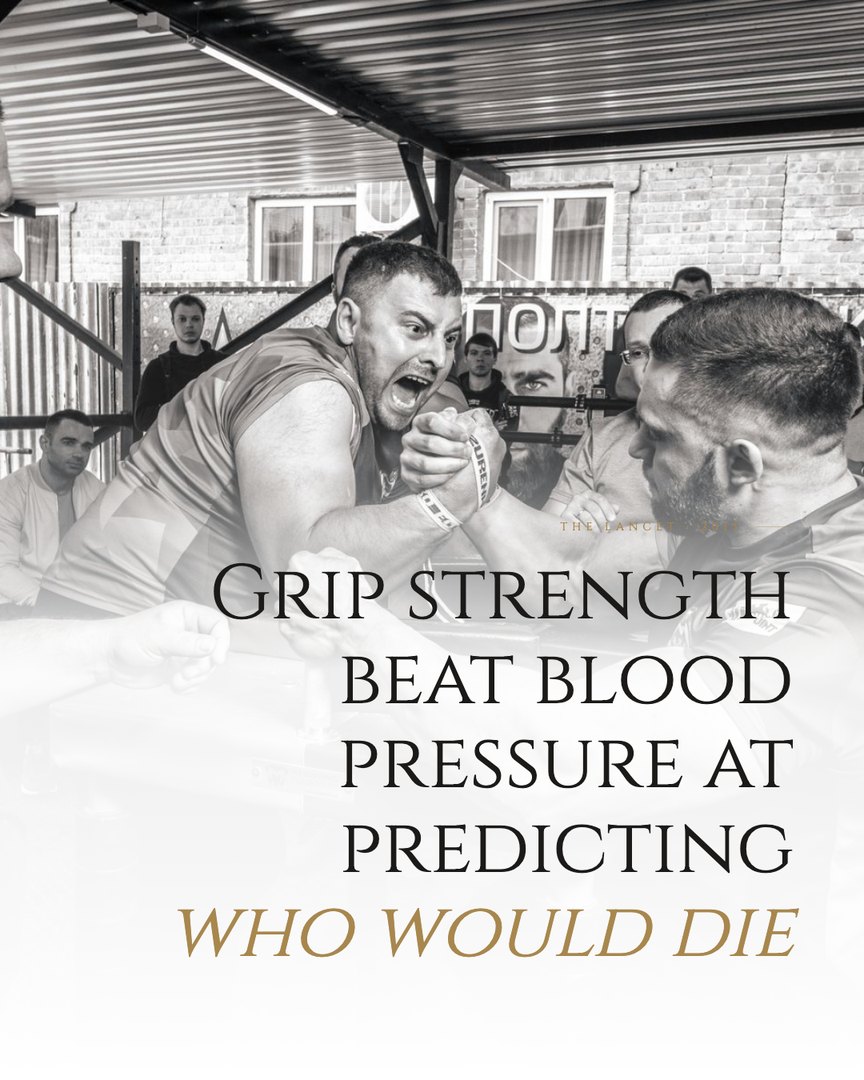
Every 5-kilogram drop in grip strength was associated with a 16 percent higher risk of death from any cause, a stronger predictor than systolic blood pressure, as it was for cardiovascular death. Weaker grip was also linked to more heart attacks and strokes over a median follow-up of four years.
Grip strength is cheap to measure and takes seconds, which is part of why researchers pushed for it to be added to routine checkups alongside blood pressure rather than instead of it. The study could not say exactly why weak grip predicts death so well, whether through general frailty, muscle loss, or something grip strength merely reflects rather than causes, and that mechanism is still being investigated.
Read the original study
Leong et al., The Lancet, 2015 · doi.org/10.1016/S0140-6736(14)62000-6
A handshake test that beat the blood pressure cuff.
Source
- Leong, D. P., Teo, K. K., Rangarajan, S., Lopez-Jaramillo, P., Avezum, A., Orlandini, A., Seron, P., Ahmed, S. H., Rosengren, A., Kelishadi, R., Rahman, O., Swaminathan, S., Iqbal, R., Gupta, R., Lear, S. A., Oguz, A., Yusoff, K., Zatonska, K., Chifamba, J., . . . Prospective Urban Rural Epidemiology (PURE) Study investigators (2015). Prognostic value of grip strength: findings from the Prospective Urban Rural Epidemiology (PURE) study. The Lancet, 386(9990), 266–73. https://doi.org/10.1016/S0140-6736(14)62000-6