
Researchers at Harvard University traced the muscle that raises each hair during a chill, the arrector pili, and the nerve that controls it, to see what else that circuit connects to inside the skin of mice.
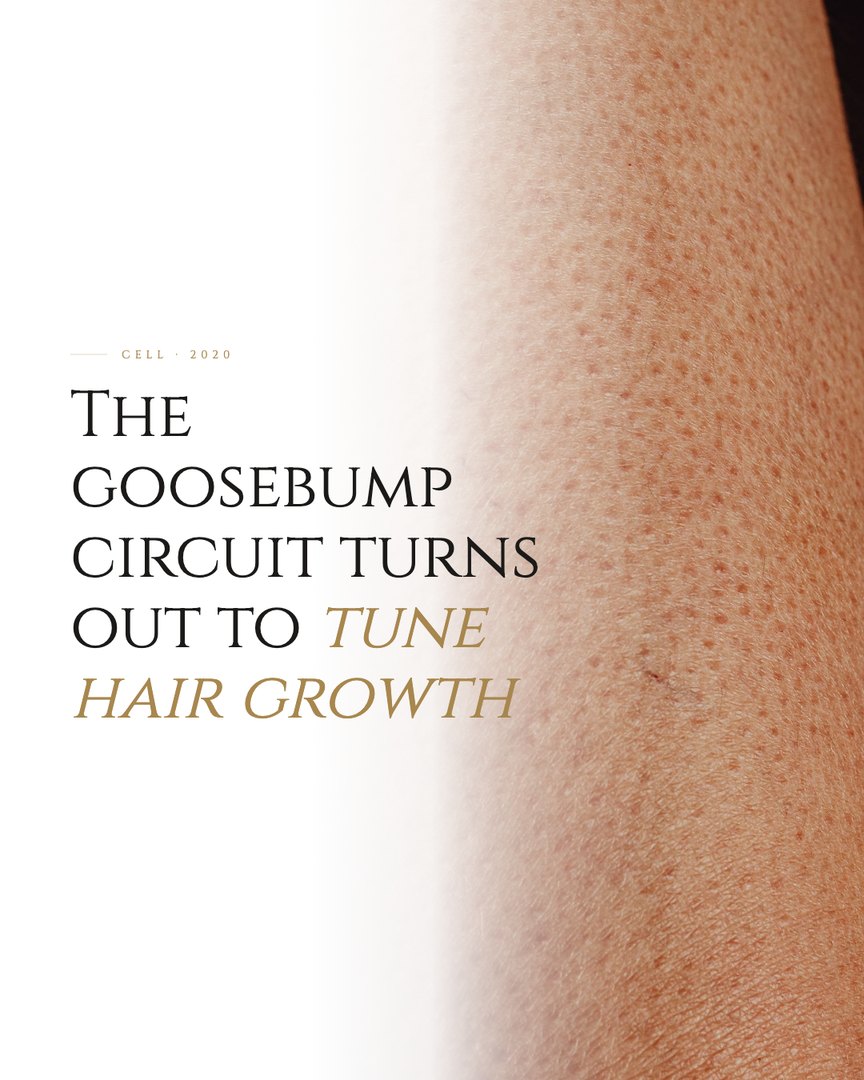
Shwartz and Hsu's team found that the arrector pili muscle and a sympathetic nerve form a niche for hair follicle stem cells, with the muscle holding the nerve in place. Prolonged cold made the nerve release norepinephrine, activating the stem cells toward new hair, alongside the muscle contraction that causes the visible bump.
The muscle was not simply one step in a shivering reflex, the researchers argued, but a long-term anchor for the nerve that helps keep the stem cells from sinking into deep dormancy, re-used repeatedly as the nerve fires in the cold. The work was done in mice, and whether the same niche drives hair regeneration in human skin the same way has not yet been directly tested.
Read the original study
Shwartz et al., Cell, 2020 · doi.org/10.1016/j.cell.2020.06.031
The chill that raises hair also grows it.
Source
- Shwartz, Y., Gonzalez-Celeiro, M., Chen, C.-L., Pasolli, H. A., Sheu, S.-H., Fan, S. M.-Y., Shamsi, F., Assaad, S., Lin, E. T.-Y., Zhang, B., Tsai, P.-C., He, M., Tseng, Y.-H., Lin, S.-J., & Hsu, Y.-C. (2020). Cell Types Promoting Goosebumps Form a Niche to Regulate Hair Follicle Stem Cells. Cell, 182(3), 578–593.e19. https://doi.org/10.1016/j.cell.2020.06.031