
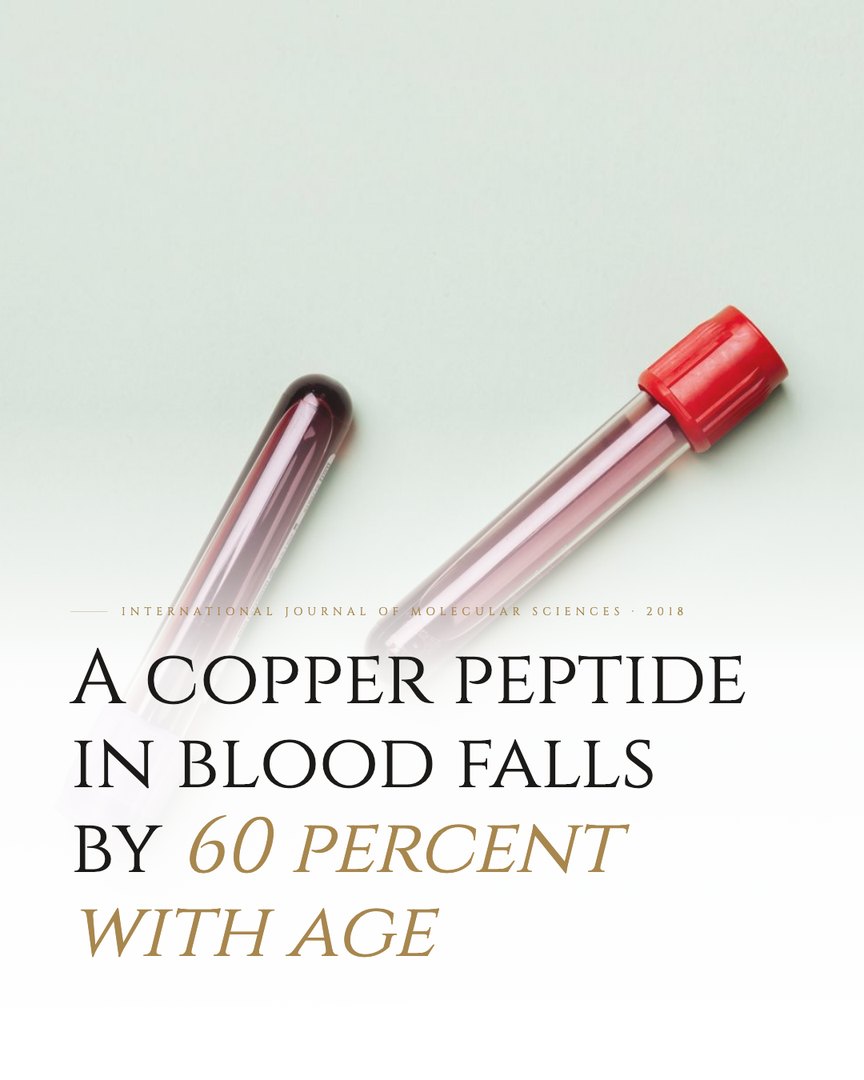
A 2018 review by Loren Pickart, who first identified the copper-binding peptide GHK in human plasma in the 1970s, summarized how its concentration changes across a lifetime.
The peer-reviewed review reports that plasma GHK measures around 200 nanograms per milliliter at age 20 and fell to around 80 nanograms per milliliter by age 60, a drop of roughly 60 percent, tracking the same decades over which skin's own ability to repair itself also declines.
A falling blood level over decades is a correlation, not proof that restoring it would reverse anything it is linked to, and much of the foundational GHK research, including this review, comes from Loren Pickart, the scientist who discovered the peptide and also built a company selling copper-peptide skincare, a financial interest worth naming. The plasma figures trace back to Pickart's own early work.
Read the original study
A declining number, and a conflict of interest.
Source
- Pickart, L., & Margolina, A. (2018). Regenerative and Protective Actions of the GHK-Cu Peptide in the Light of the New Gene Data. International Journal of Molecular Sciences, 19(7). https://doi.org/10.3390/ijms19071987