
Scientists at Imperial College London engineered a gene drive, a self-copying DNA edit that spreads through a species, targeting a fertility gene called doublesex. Unlike a pesticide, it was built to inherit itself into every future mosquito generation.
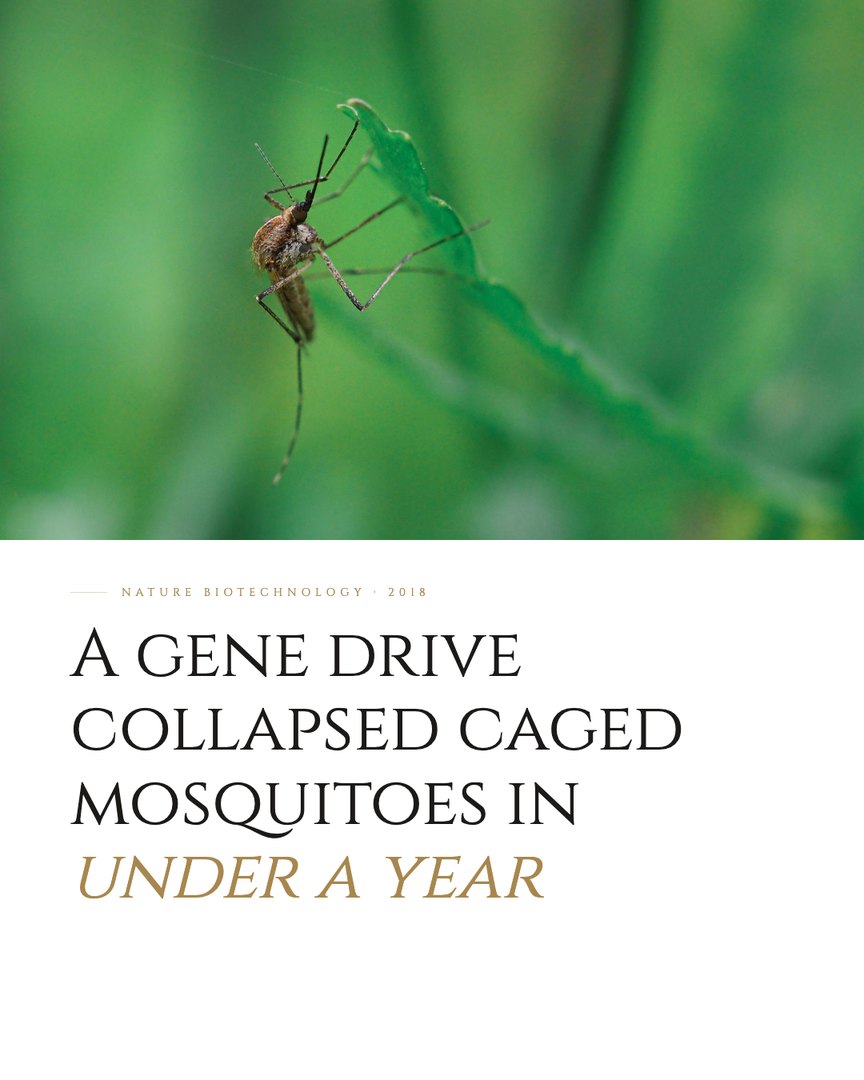
Researchers released the edited gene into caged populations of Anopheles gambiae, the mosquito that spreads malaria in Africa. The modified DNA spread to 100 percent of the insects within 7 to 11 generations, and every caged population collapsed completely, producing no further offspring.
The result held across repeated trials in small cages, the first time a gene drive had driven an animal population to extinction in a laboratory setting. Field trials remain years away, with regulators and local communities still weighing a technology designed to spread permanently through a wild species, and effects outside a cage are still unproven.
Read the original study
Kyrou et al., Nature Biotechnology, 2018 · doi.org/10.1038/nbt.4245
Extinction, engineered in a cage.
Source
- Kyrou, K., Hammond, A. M., Galizi, R., Kranjc, N., Burt, A., Beaghton, A. K., Nolan, T., & Crisanti, A. (2018). A CRISPR-Cas9 gene drive targeting doublesex causes complete population suppression in caged Anopheles gambiae mosquitoes. Nature Biotechnology, 36(11), 1062–1066. https://doi.org/10.1038/nbt.4245