
Researchers at Public Health Ontario and the Institute for Clinical Evaluative Sciences linked laboratory-confirmed influenza test results to hospital records for acute myocardial infarction, comparing each patient's own risk in the days after infection against their risk at other times.
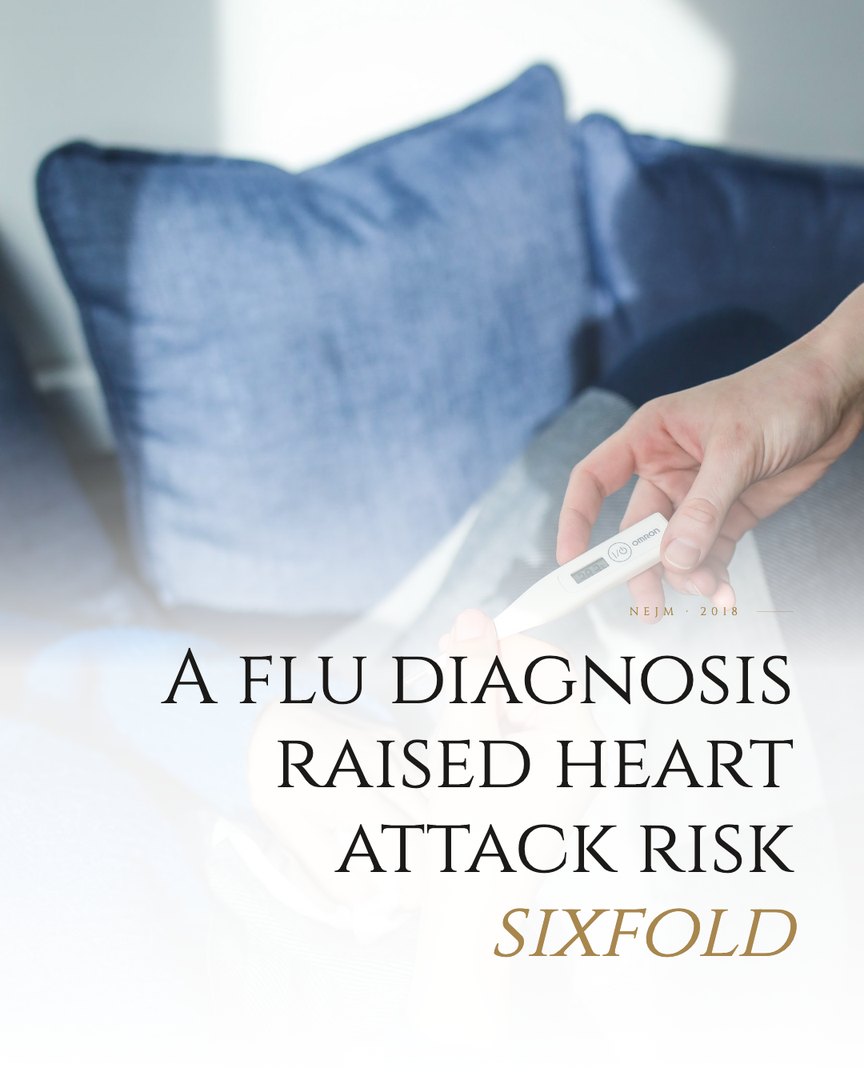
Using a self-controlled design, where each patient serves as their own comparison, the team found the risk of a heart attack was about six times higher in the week immediately following a laboratory-confirmed flu infection than in the year before and after, based on 364 heart attack admissions. No increase was seen after day seven.
Because every patient was compared only against their own baseline risk, the design cancels out stable factors such as sex, genetics or long-term heart disease. The study used laboratory-confirmed cases rather than every flu-like illness, which makes the link more precise but also means it understates how many unconfirmed cases carry the same risk. The finding has strengthened public health arguments for flu vaccination as heart protection.
Read the original study
Kwong et al., New England Journal of Medicine, 2018 · doi.org/10.1056/NEJMoa1702090
A respiratory virus turned out to strain hearts too.
Source
- Kwong, J. C., Schwartz, K. L., Campitelli, M. A., Chung, H., Crowcroft, N. S., Karnauchow, T., Katz, K., Ko, D. T., McGeer, A. J., McNally, D., Richardson, D. C., Rosella, L. C., Simor, A., Smieja, M., Zahariadis, G., & Gubbay, J. B. (2018). Acute Myocardial Infarction after Laboratory-Confirmed Influenza Infection. New England Journal of Medicine, 378(4), 345–353. https://doi.org/10.1056/NEJMoa1702090