
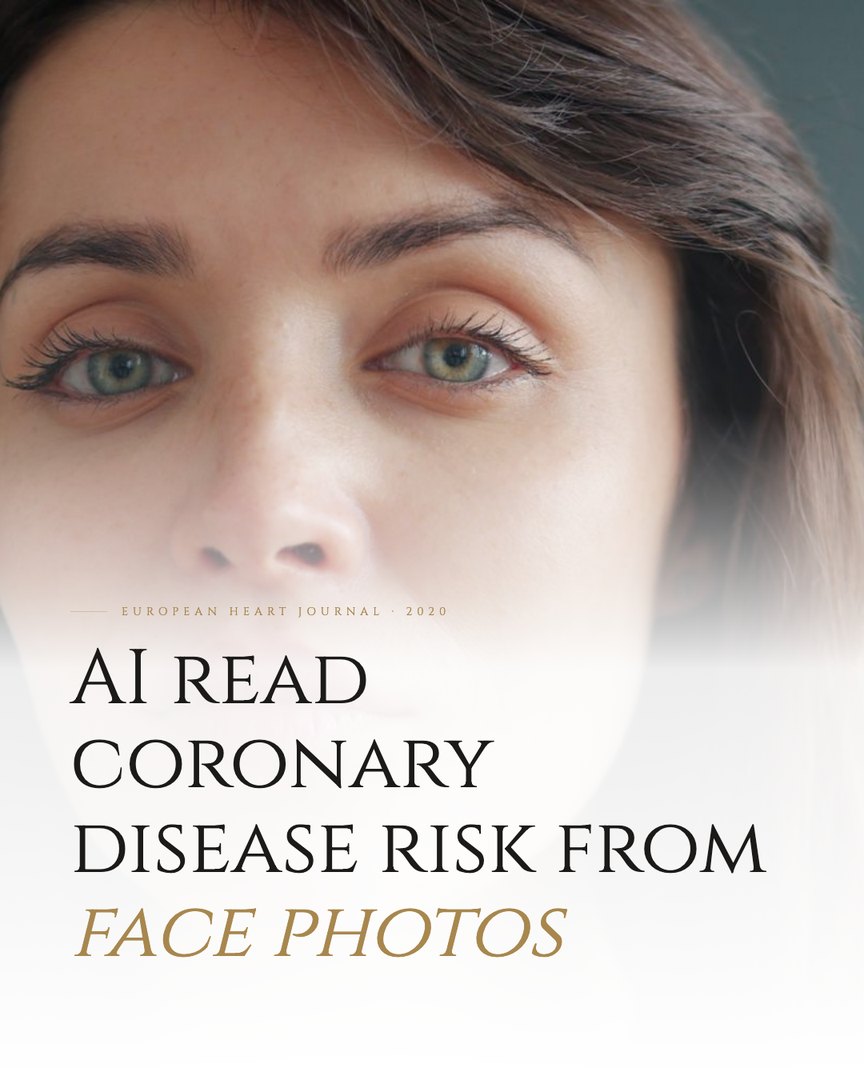
Researchers led by Fuwai Hospital in Beijing photographed the faces of 5,796 patients undergoing coronary imaging and trained a deep learning model to estimate the probability of coronary artery disease from the photos alone.
In a separate test group of over 1,000 patients, the model identified coronary artery disease with higher overall accuracy than standard clinical risk scores, correctly flagging about 80 percent of true cases, though it also flagged a meaningful share of people without disease as higher risk.
A facial photo is not proposed as a replacement for angiography or blood tests, and the model has only been validated in Chinese hospital populations, so it is unclear how it performs across other ancestries or lighting conditions. The researchers describe it as a low-cost screening flag meant to prompt further testing, not a stand-alone diagnosis.
Read the original study
Lin et al., European Heart Journal, 2020 · doi.org/10.1093/eurheartj/ehaa640
A face photo carried a clue about the heart.
Source
- Lin, S., Li, Z., Fu, B., Chen, S., Li, X., Wang, Y., Wang, X., Lv, B., Xu, B., Song, X., Zhang, Y.-J., Cheng, X., Huang, W., Pu, J., Zhang, Q., Xia, Y., Du, B., Ji, X., & Zheng, Z. (2020). Feasibility of using deep learning to detect coronary artery disease based on facial photo. European Heart Journal, 41(46), 4400–4411. https://doi.org/10.1093/eurheartj/ehaa640