
Researchers at the University of Cambridge pooled data from 196 earlier studies covering more than 30 million participants, mapping out exactly how mortality risk changed at every level of physical activity, from none at all up through the recommended weekly target.
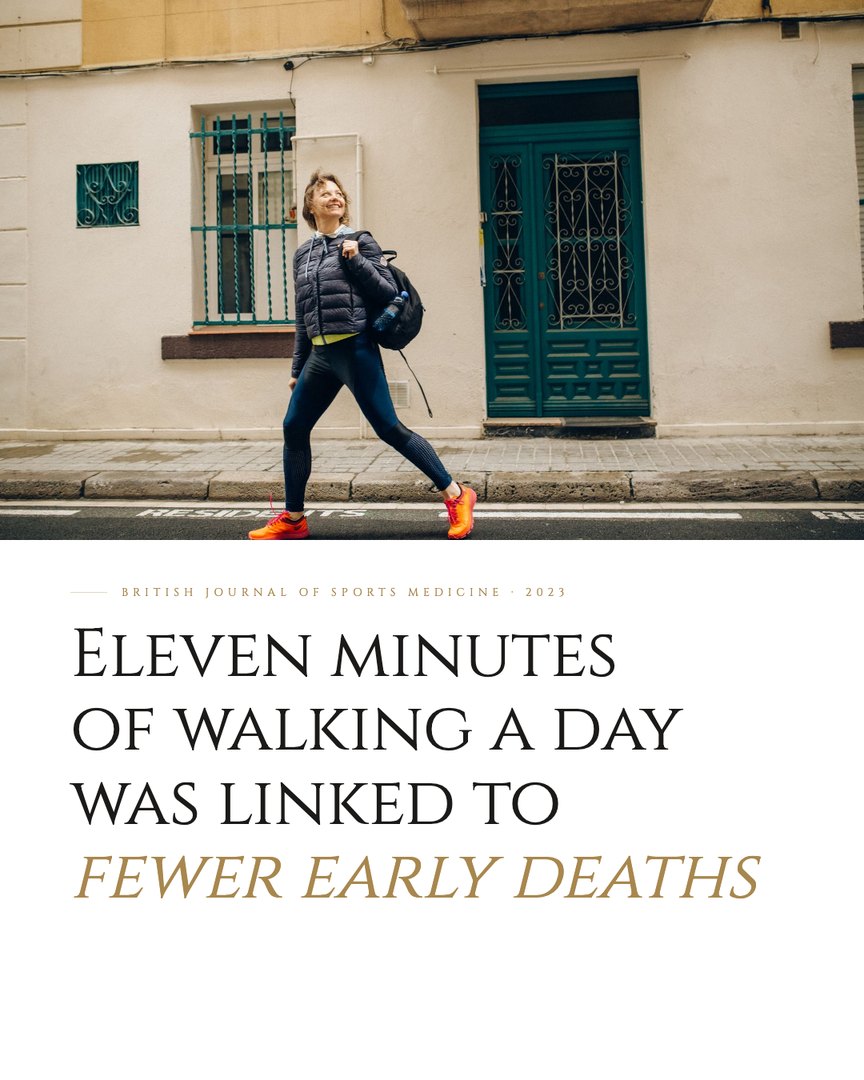
The dose-response analysis found that even at half the standard 150-minutes-a-week target, activity equivalent to about 11 minutes of brisk walking a day was linked to a meaningfully lower risk of early death, heart disease, and cancer, with the steepest drop in risk occurring at the lowest activity levels.
Each additional increment of activity kept lowering risk, but the biggest gains came from moving people out of complete inactivity rather than from pushing already-active people further. The analysis combined observational studies that track activity and health over time rather than controlled trials, so it shows a strong association rather than definitive proof that walking itself causes the lower risk, though the pattern held across a very large combined sample.
Read the original study
Garcia et al., British Journal of Sports Medicine, 2023 · doi.org/10.1136/bjsports-2022-105669
A short walk, a measurably lower risk.
Source
- Garcia, L., Pearce, M., Abbas, A., Mok, A., Strain, T., Ali, S., Crippa, A., Dempsey, P. C., Golubic, R., Kelly, P., Laird, Y., McNamara, E., Moore, S., de Sa, T. H., Smith, A. D., Wijndaele, K., Woodcock, J., & Brage, S. (2023). Non-occupational physical activity and risk of cardiovascular disease, cancer and mortality outcomes: a dose-response meta-analysis of large prospective studies. British Journal of Sports Medicine, 57(15), 979–989. https://doi.org/10.1136/bjsports-2022-105669