
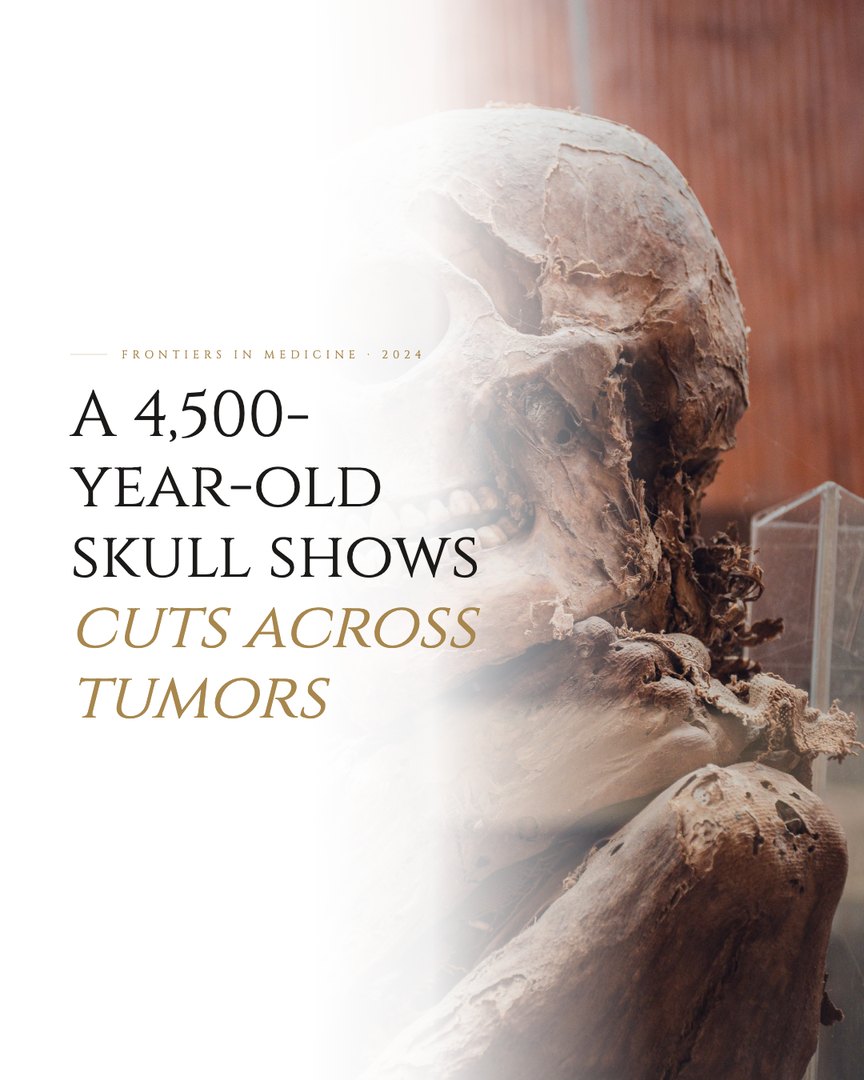
Researchers from the University of Tübingen and Santiago de Compostela examined two Egyptian skulls held at the University of Cambridge, one from the Old Kingdom roughly 4,500 years ago and one from the Late Period about 2,000 years later.
Under a microscope, the older skull showed small, round lesions consistent with cancer that had spread, and small, straight cut marks made around the time of death ran across two of them. Their position suggested someone had deliberately worked on the growths rather than causing the marks by accident.
The authors are careful not to overclaim: the marks could reflect a surgical attempt to treat or remove the tumor, or just as plausibly a postmortem examination to understand what had killed the person, and with only two incomplete skulls to study, no broader pattern of ancient Egyptian cancer treatment can be drawn from this alone.
Read the original study
Tondini et al., Frontiers in Medicine, 2024 · doi.org/10.3389/fmed.2024.1371645
Even old bones can still testify.
Source
- Tondini, T., Isidro, A., & Camarós, E. (2024). Case report: Boundaries of oncological and traumatological medical care in ancient Egypt: new palaeopathological insights from two human skulls. Frontiers in Medicine, 11, 1371645. https://doi.org/10.3389/fmed.2024.1371645