
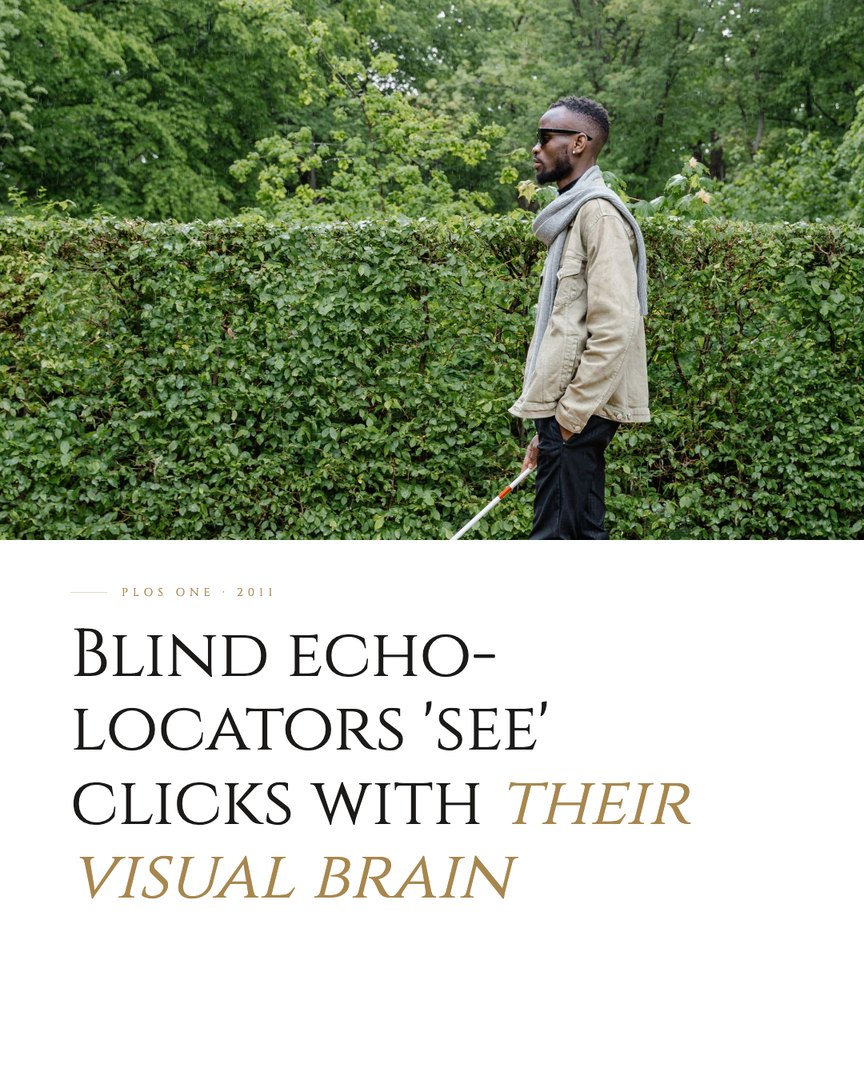
Researchers at Western University in Canada scanned the brains of two expert echolocators, one blind from early childhood and one blind later in life, while they listened to recordings of their own clicks either containing echoes from objects or stripped of any echo information.
When the clicks carried real echo information, activity rose sharply in the calcarine cortex, the region that processes vision in sighted people, while regions typically devoted to hearing showed little extra response. Both echolocators also showed activity in motion-processing areas when the echoes came from moving objects, mirroring how a sighted brain tracks movement by eye.
The pattern suggested that echolocation functionally recruits the brain's visual system to build a spatial picture from sound, rather than simply sharpening normal hearing. The study examined only two expert echolocators, both unusually skilled after years of practice, so it describes what an expert brain can do rather than what happens automatically in every blind person who tries the technique.
Read the original study
Thaler, Arnott and Goodale, PLoS ONE, 2011 · doi.org/10.1371/journal.pone.0020162
Sound borrowed the brain's seeing machinery.
Source
- Thaler, L., Arnott, S. R., & Goodale, M. A. (2011). Neural correlates of natural human echolocation in early and late blind echolocation experts. PLOS ONE, 6(5), e20162. https://doi.org/10.1371/journal.pone.0020162