
General practitioners writing in the BMJ's Christmas issue, a slot the journal reserves for odd but real findings, decided to measure the claim directly across adults of different ages.
Measuring ear length in 206 patients aged 30 to 93, the doctors found a steady, near-linear rise with age, about 0.22 millimeters for each year, with no sign of leveling off even in the oldest patients.
The report did not test why, and because each person was measured once, it shows longer ears in older people rather than tracking any one ear over time. The sample and method were modest by the standard of a full-length original study, fitting for a short Christmas report, but the pattern has been noted again by other clinicians since.
Read the original study
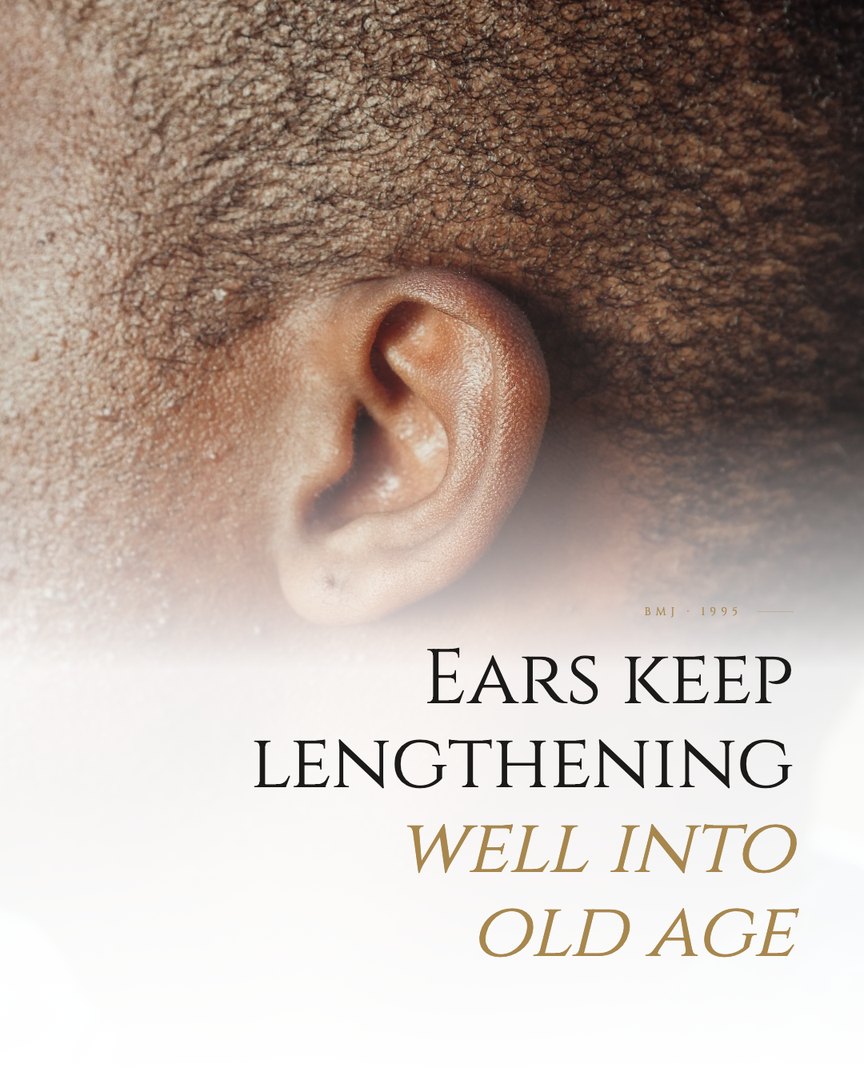
Older ears were longer, all the way to 93.
Source
- Heathcote, J. A. (1995). Why do old men have big ears? BMJ, 311(7021), 1668. https://doi.org/10.1136/bmj.311.7021.1668