
Researchers at King's College London tested the opposite approach in the EAT study, randomly assigning 1,303 exclusively breastfed three-month-olds to either early introduction of six allergenic foods or continued breastfeeding alone until about six months.
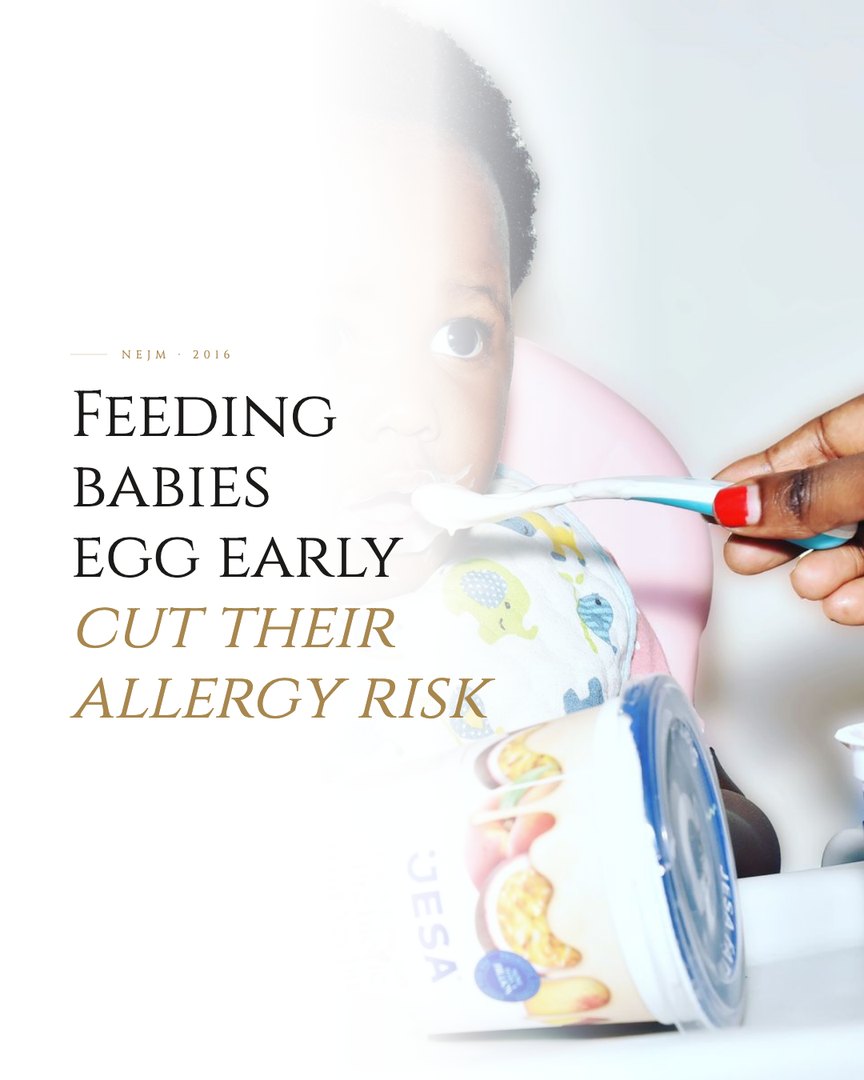
Among infants who actually ate the prescribed amount of egg consistently, egg allergy appeared in just 1.4 percent, compared with 5.5 percent in the group that waited, a 75 percent relative reduction. Overall study-wide results were smaller, because many families in the early-introduction group struggled to keep up the schedule.
The finding helped reverse decades of pediatric guidance built on the opposite assumption, and early introduction of egg and peanut is now widely recommended. The catch the researchers flagged was adherence: the protective effect showed up clearly only in infants who actually ate the foods regularly, not simply those assigned to try.
Read the original study
The old advice had the direction backwards.
Source
- Perkin, M. R., Logan, K., Tseng, A., Raji, B., Ayis, S., Peacock, J., Brough, H., Marrs, T., Radulovic, S., Craven, J., Flohr, C., & Lack, G. (2016). Randomized Trial of Introduction of Allergenic Foods in Breast-Fed Infants. New England Journal of Medicine, 374(18), 1733–1743. https://doi.org/10.1056/NEJMoa1514210