
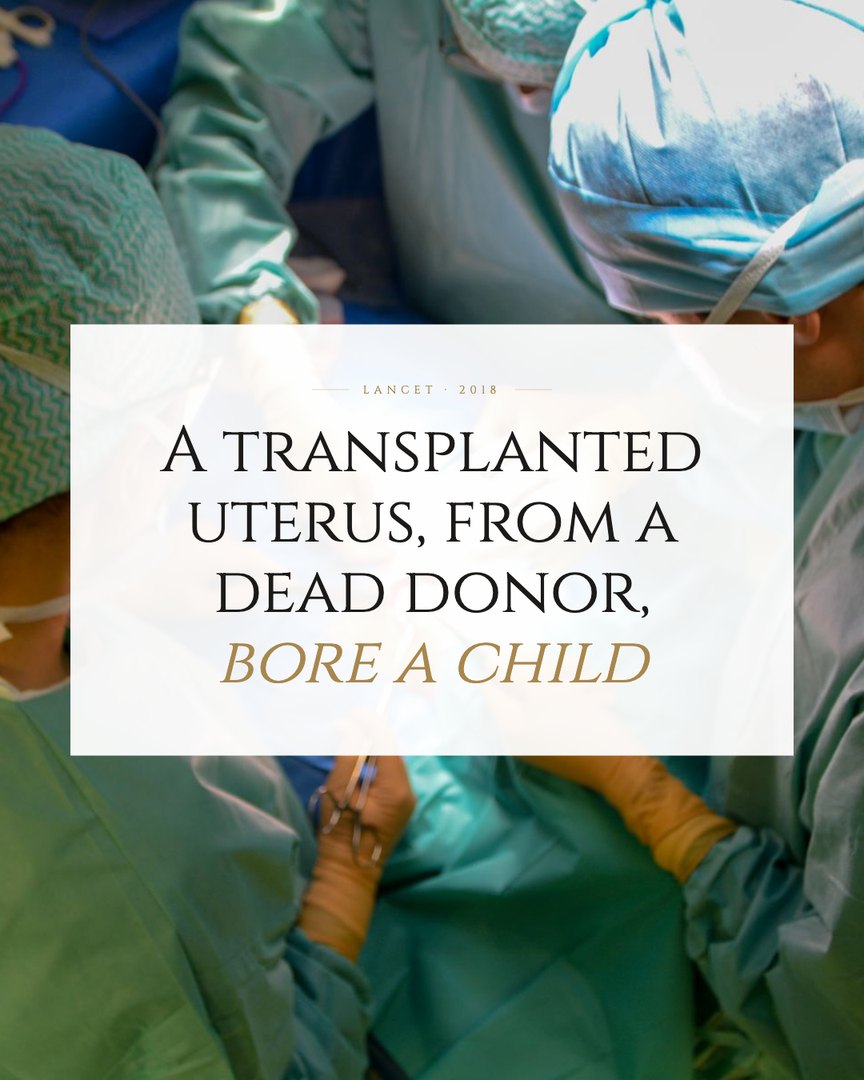
A 32-year-old woman born without a functioning uterus received one from a 45-year-old donor who had died of a brain haemorrhage, the first time a uterus from a deceased donor led to a live birth.
Her first period came 37 days after the ten-hour transplant surgery and recurred on a regular cycle. Doctors transferred a single embryo seven months later, and the pregnancy proceeded normally. She delivered a healthy girl by cesarean section at about 36 weeks, with top Apgar scores.
Living-donor uterus transplants had already produced births, but living donors are scarce and the surgery to remove a uterus from a living person carries its own risk. A deceased donor removes that risk for the donor, at the cost of a donor organ that may have been without blood flow for longer. The uterus was removed after the birth, so the recipient would not need lifelong immune-suppressing drugs.
Read the original study
Ejzenberg et al., Lancet, 2018 · doi.org/10.1016/S0140-6736(18)31766-5
A donor who had died gave her a daughter.
Source
- Ejzenberg, D., Andraus, W., Baratelli Carelli Mendes, L. R., Ducatti, L., Song, A., Tanigawa, R., Rocha-Santos, V., Macedo Arantes, R., Soares, J. M., Serafini, P. C., Bertocco de Paiva Haddad, L., Pulcinelli Francisco, R., Carneiro D'Albuquerque, L. A., & Chada Baracat, E. (2019). Livebirth after uterus transplantation from a deceased donor in a recipient with uterine infertility. The Lancet, 392(10165), 2697–2704. https://doi.org/10.1016/S0140-6736(18)31766-5