
Researchers running the DAWN trial tested whether removing the clot mechanically, using imaging to find patients whose brain tissue was still salvageable, could help even many hours after the stroke began, far outside the usual treatment window.
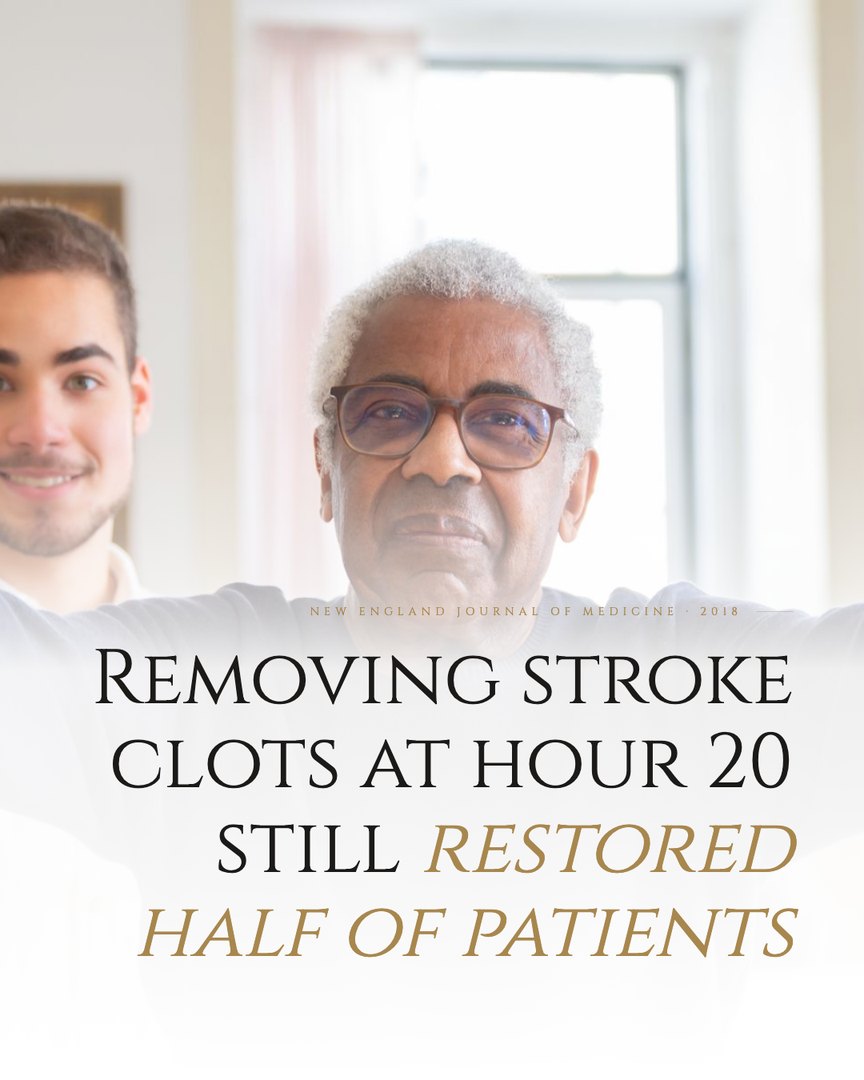
Across 206 patients treated 6 to 24 hours after stroke onset, thrombectomy plus standard care left 49 percent functionally independent at 90 days, compared with just 13 percent among those given standard care alone, a gap so large the trial stopped early.
Patients were selected using brain scans that measured how much tissue was already dead versus still at risk, rather than relying on the clock alone, which let doctors find candidates who still had a lot to gain many hours out. Later trials confirmed similar results, and imaging-based selection is now standard for stroke centers treating patients who wake up with symptoms or arrive late.
Read the original study
Nogueira et al., New England Journal of Medicine, 2018 · doi.org/10.1056/NEJMoa1706442
Hours later, half still recovered.
Source
- Nogueira, R. G., Jadhav, A. P., Haussen, D. C., Bonafe, A., Budzik, R. F., Bhuva, P., Yavagal, D. R., Ribo, M., Cognard, C., Hanel, R. A., Sila, C. A., Hassan, A. E., Millan, M., Levy, E. I., Mitchell, P., Chen, M., English, J. D., Shah, Q. A., Silver, F. L., . . . Jovin, T. G. (2018). Thrombectomy 6 to 24 Hours after Stroke with a Mismatch between Deficit and Infarct. New England Journal of Medicine, 378(1), 11–21. https://doi.org/10.1056/NEJMoa1706442