
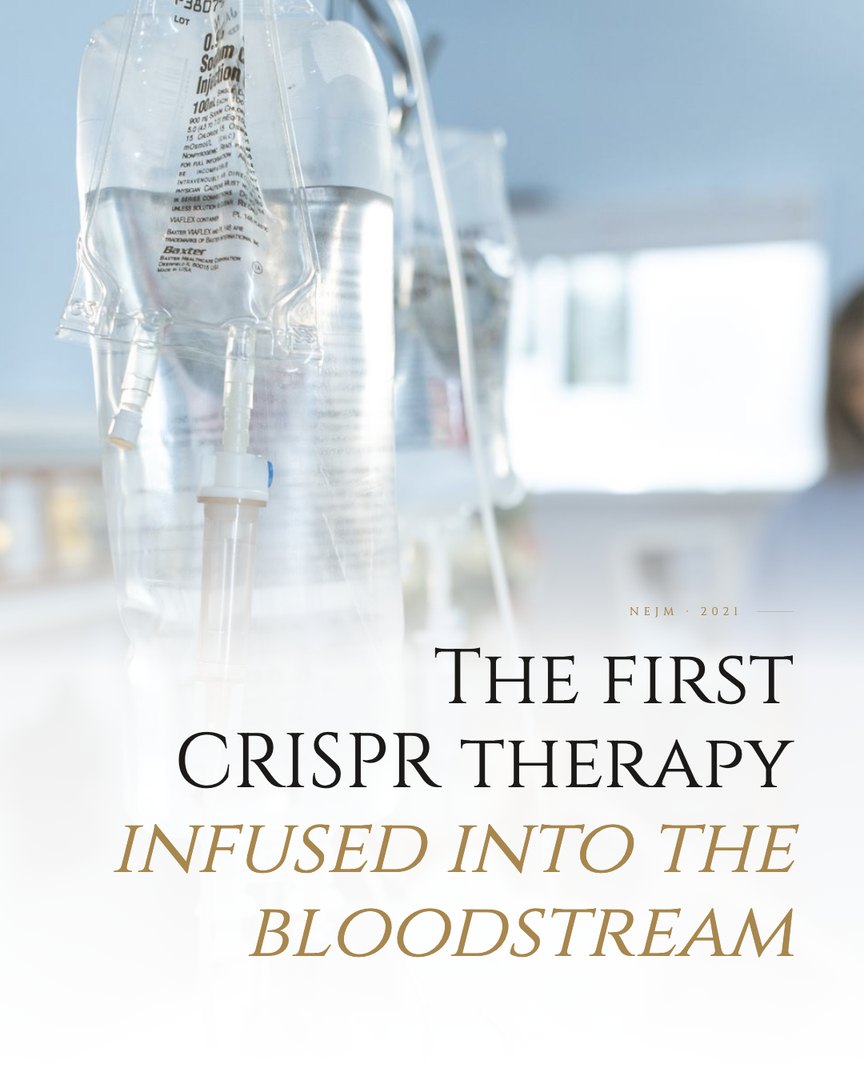
Researchers at University College London instead infused the gene-editing machinery itself directly into the bloodstream, packaged in fat droplets designed to be taken up by the liver, to treat a hereditary disease caused by a misfolded protein called transthyretin.
In six patients with hereditary transthyretin amyloidosis, a single intravenous infusion of NTLA-2001 cut the faulty protein's level in the blood by an average of 87 percent at the higher of two doses tested, with one patient reaching a 96 percent reduction, from a single treatment.
Because CRISPR cannot yet be aimed with certainty everywhere in the genome, the long-term risk of off-target edits accumulating over a patient's lifetime is still being watched in extended follow-up. The approach has since been tested for other liver-driven diseases, including a form of high cholesterol, making the liver one of the first organs where in-body gene editing looks practical at scale.
Read the original study
Gene editing stopped waiting outside the body.
Source
- Gillmore, J. D., Gane, E., Taubel, J., Kao, J., Fontana, M., Maitland, M. L., Seitzer, J., O'Connell, D., Walsh, K. R., Wood, K., Phillips, J., Xu, Y., Amaral, A., Boyd, A. P., Cehelsky, J. E., McKee, M. D., Schiermeier, A., Harari, O., Murphy, A., . . . Lebwohl, D. (2021). CRISPR-Cas9 In Vivo Gene Editing for Transthyretin Amyloidosis. New England Journal of Medicine, 385(6), 493–502. https://doi.org/10.1056/NEJMoa2107454