
A multicenter team led by Jeffrey Bazarian of the University of Rochester tested whether two proteins released by injured brain tissue, measured from a simple blood draw, could reliably predict which patients had nothing to find on a scan.
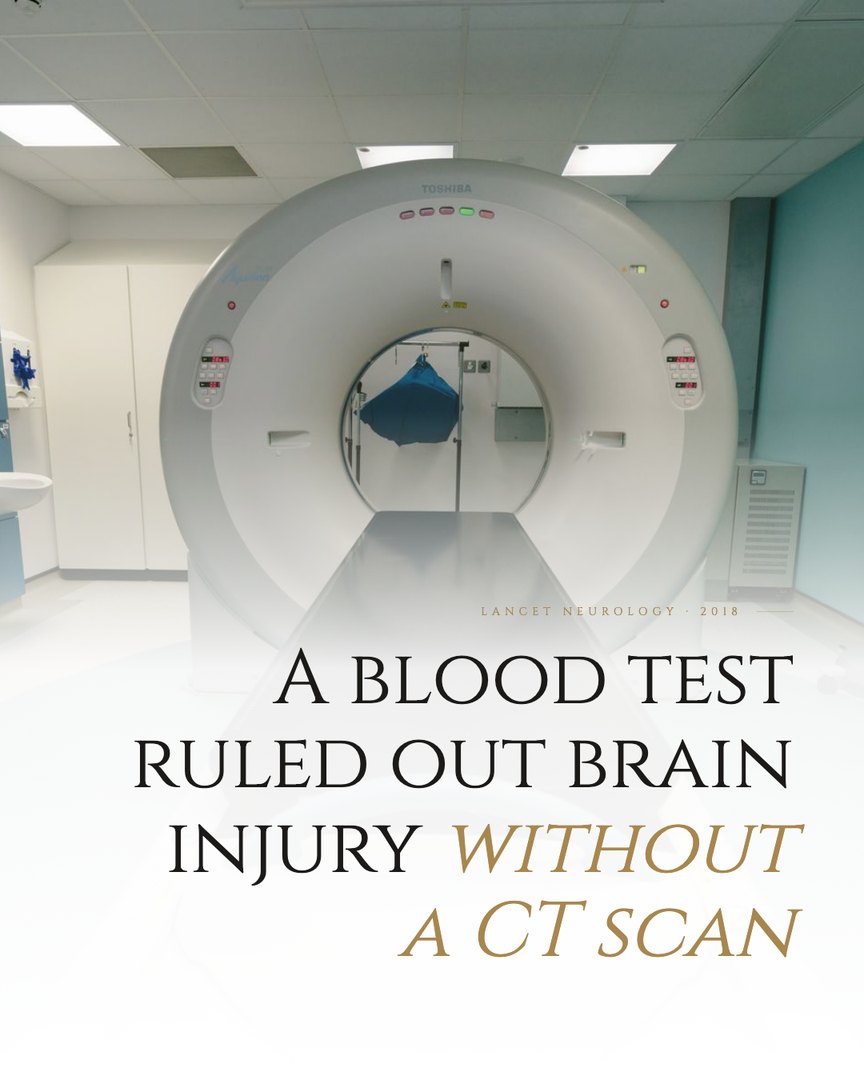
Among 1,959 adults with suspected mild to moderate head injury, the combined test for the proteins GFAP and UCH-L1 correctly flagged 97.6 percent of patients who did have a CT-visible brain injury and, more usefully, a negative result was right 99.6 percent of the time, with a clean scan.
A negative result that reliable means many patients could, in principle, skip a CT scan entirely, saving radiation exposure and emergency department time. The test was approved for clinical use within a defined time window of 12 hours after injury, and it still misses a small number of cases, so it supplements clinical judgment rather than replacing the scan outright for every patient.
Read the original study
Bazarian et al., Lancet Neurology, 2018 · doi.org/10.1016/S1474-4422(18)30231-X
A blood draw, not a radiation dose.
Source
- Bazarian, J. J., Biberthaler, P., Welch, R. D., Lewis, L. M., Barzo, P., Bogner-Flatz, V., Gunnar Brolinson, P., Büki, A., Chen, J. Y., Christenson, R. H., Hack, D., Huff, J. S., Johar, S., Jordan, J. D., Leidel, B. A., Lindner, T., Ludington, E., Okonkwo, D. O., Ornato, J., . . . Jagoda, A. S. (2018). Serum GFAP and UCH-L1 for prediction of absence of intracranial injuries on head CT (ALERT-TBI): a multicentre observational study. The Lancet Neurology, 17(9), 782–789. https://doi.org/10.1016/S1474-4422(18)30231-X