
Researchers at St. Jude Children's Research Hospital tracked how decades of incremental trial results, adding drug combinations, timing, and treatment aimed at the central nervous system, pushed survival for the same diagnosis far higher by the 2010s.
Early chemotherapy alone put most children into initial remission but nearly all relapsed, often in the central nervous system, and long-term survival stayed near 10 to 20 percent for years. Adding cranial or craniospinal radiation and injecting chemotherapy directly into the spinal fluid cut those relapses sharply, and later refinements pushed 5-year survival rates up to roughly 90 percent.
No single breakthrough produced the change; it came from decades of cooperative trials comparing slightly different drug combinations and schedules across major treatment centers, each adjustment adding a few more percentage points. The same disease that was a near-certain death sentence for a child in 1960 is now one of the most curable childhood cancers, though relapsed and high-risk cases still carry a far tougher prognosis.
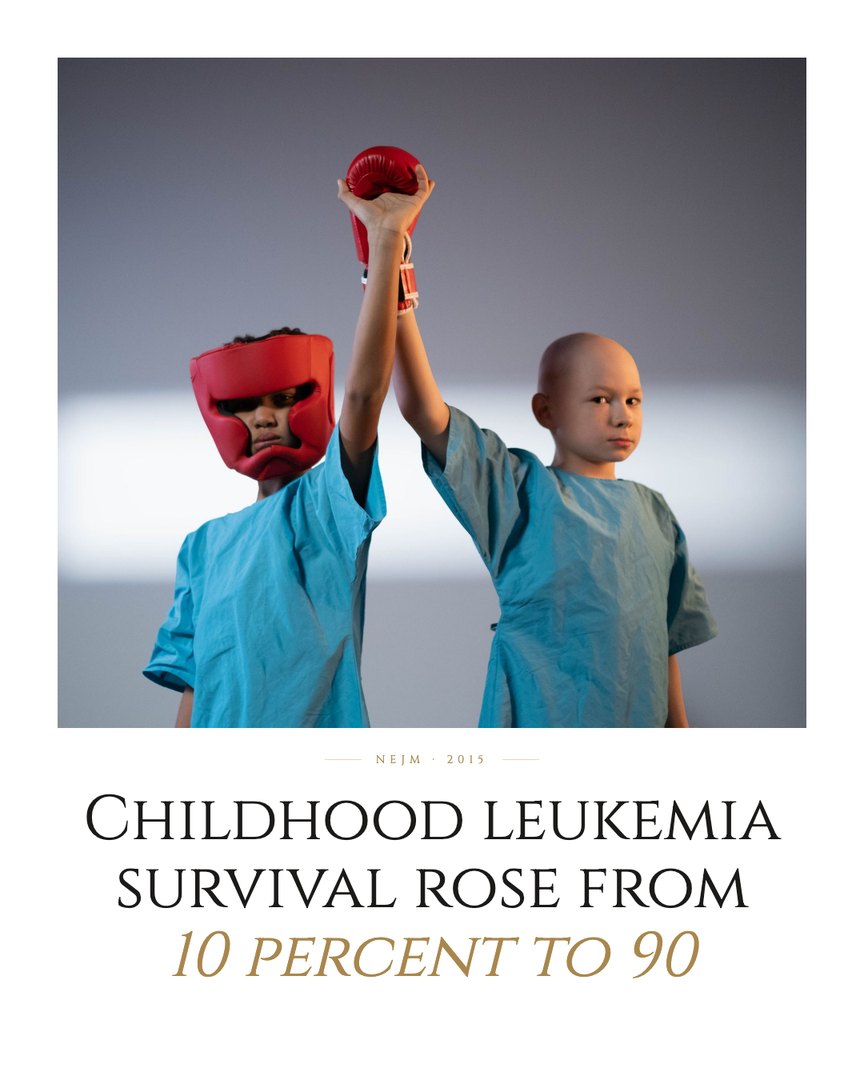
Sixty years turned a death sentence into a cure.
Source
- Pui et al., NEJM, 2015 · St. Jude Children's Research Hospital