
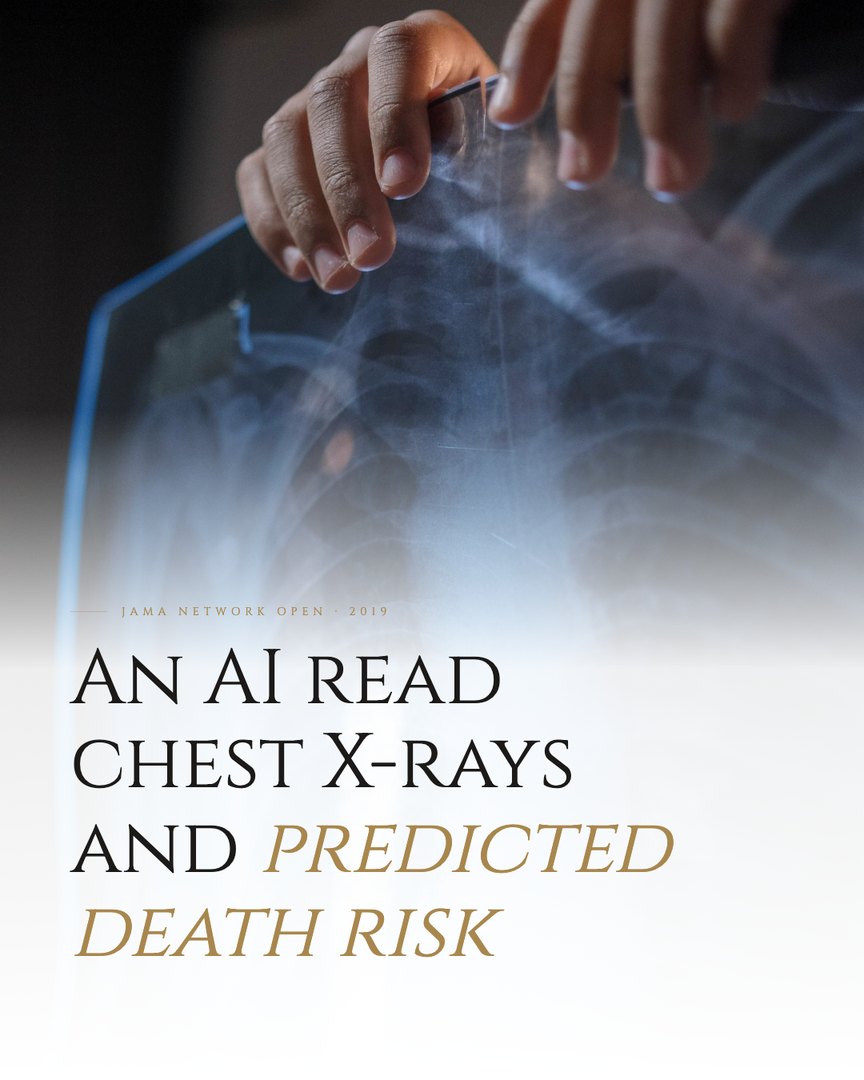
Researchers at Massachusetts General Hospital trained a deep learning model, CXR-risk, on chest X-rays paired with each patient's long-term outcome, teaching it to read patterns radiologists are not trained to score as risk.
The model was tested on more than 15,000 people from two separate cancer-screening trials. Patients it flagged as very high risk died at a rate of 53 percent within 12 years in one trial and 34 percent within 6 years in the other, a death hazard 15 to 18 times that of patients scored very low risk.
No genetic data or blood test went into the score, only shadows and shapes already visible on a scan most patients had taken for an unrelated reason. The model is not a diagnosis, and a high score does not say what a patient will die from, only that the risk is elevated. Researchers see it as a free second opinion already sitting in hospital archives.
Read the original study
Lu et al., JAMA Network Open, 2019 · doi.org/10.1001/jamanetworkopen.2019.7416
A lifespan clue hiding in old X-rays.
Source
- Lu, M. T., Ivanov, A., Mayrhofer, T., Hosny, A., Aerts, H. J. W. L., & Hoffmann, U. (2019). Deep Learning to Assess Long-term Mortality From Chest Radiographs. JAMA Network Open, 2(7), e197416. https://doi.org/10.1001/jamanetworkopen.2019.7416