
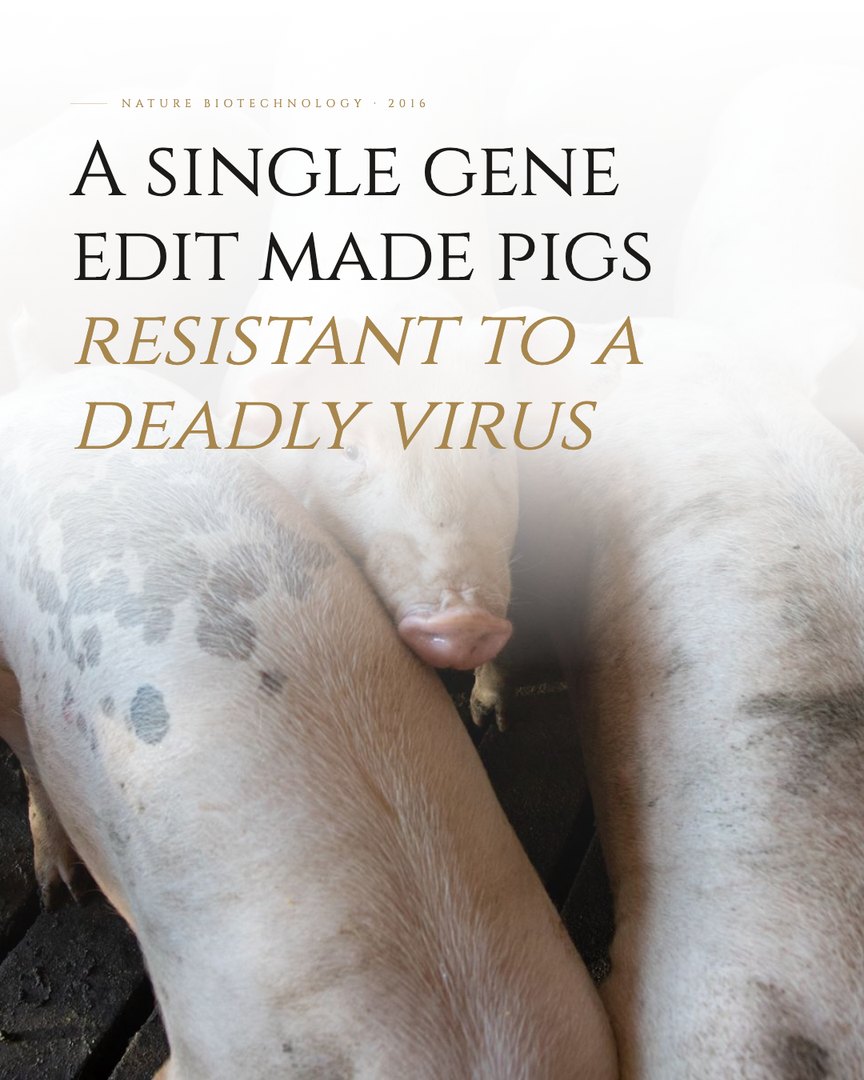
Researchers at the University of Missouri used gene editing to knock out the gene for CD163, a protein on pig cells that the PRRS virus uses as its entry point, reasoning that without the right doorway the virus could not get in at all.
The edited pigs grew and developed normally, with no signs the missing CD163 caused them any harm. When exposed to the PRRS virus directly, the edited pigs showed no signs of infection at all, while unedited pigs in the same test became infected as expected.
Removing the virus's entry point worked where decades of vaccines aimed at the virus had given only partial protection. A related CD163 edit made by the breeding company PIC won US FDA approval in 2025, though export markets must still approve it before wide commercial use.
Read the original study
Whitworth et al., Nature Biotechnology, 2016 · doi.org/10.1038/nbt.3434
No doorway for the virus, no infection.
Source
- Whitworth, K. M., Rowland, R. R. R., Ewen, C. L., Trible, B. R., Kerrigan, M. A., Cino-Ozuna, A. G., Samuel, M. S., Lightner, J. E., McLaren, D. G., Mileham, A. J., Wells, K. D., & Prather, R. S. (2016). Gene-edited pigs are protected from porcine reproductive and respiratory syndrome virus. Nature Biotechnology, 34(1), 20–2. https://doi.org/10.1038/nbt.3434